








































Most business owners evaluate creative tools by asking: “Which one makes the prettiest pictures?”
In a commercial operation—whether you run retail stores, an e-commerce platform, or a lead-driven service business—that is the wrong question.
The real question is: “Where does this tool sit inside our revenue workflow, and what happens when its output hits the rest of the business?”
An image is never the final outcome. It is an input into an ad campaign, an e-commerce product page, a WhatsApp sales broadcast, a store shelf-talker, or an inventory catalog. When creative tools don’t connect cleanly with operational systems, they create expensive friction: delayed product launches, ad budget wasted on non-compliant graphics, mismatched product SKUs, and disconnected sales follow-ups.
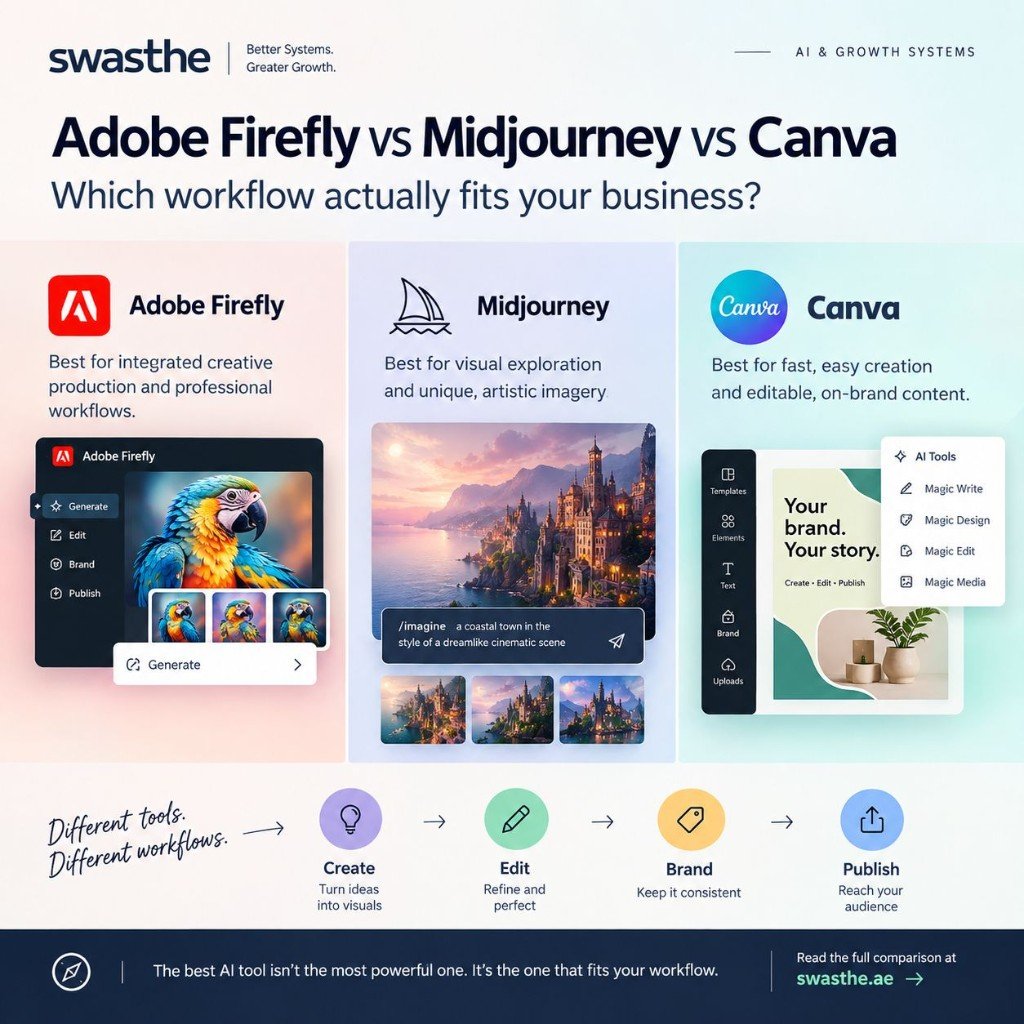
If you are comparing Canva vs Midjourney vs Adobe for a commercial operation, start with where each tool sits in the revenue workflow—not which one makes the prettiest picture. Here is an operational breakdown of Midjourney, Canva, and Adobe, which business scenarios they fit, and what happens when they connect to the rest of your business systems.
Part 1: The three tools and their operational roles
| Ideation and mood | Rapid asset assembly | Precision and production |
|---|---|---|
| Midjourney | Canva | Adobe Creative Cloud |
| “What should this look and feel like?” | “We need 12 promo tiles for WhatsApp and Meta by 4 PM” | “We need print-ready packaging, pixel-clean product cutouts and vectors” |
1. Midjourney: the concept and ideation engine
What it does: Generates striking, high-aesthetic imagery from pure text prompts.
The business role: Creative direction, campaign mood boards, lifestyle backdrops, and conceptual ideation.
Where it breaks down: It does not understand product accuracy, layers, vector typography, or brand guidelines. You cannot ask Midjourney to accurately render your specific product SKU, barcode, or Arabic/English dual typography.
2. Canva (Magic Studio): the velocity engine
What it does: Empowers non-designers (marketers, store managers, social teams) to assemble complete, templated layouts using drag-and-drop tools and lightweight AI.
The business role: Daily promotional assets, social media announcements, fast WhatsApp broadcast cards, seasonal flash-sale banners, and team presentations.
Where it breaks down: It lacks deep pixel-level retouching, fine color-space management (CMYK print profiles), and raw vector engineering. When used without centralized brand kits, it can lead to fragmented, off-brand collateral.
3. Adobe (Firefly + Creative Cloud): the production and compliance engine
What it does: Professional-grade compositing (Photoshop), scalable vector graphics (Illustrator), and color-accurate print preparation, with AI (Firefly) embedded directly into non-destructive layer workflows.
The business role: Master brand assets, packaging, packaging mockups, multi-language vector typography, high-resolution product retouching, and legally indemnified commercial ad campaigns.
Where it breaks down: High software licensing costs, steep learning curves, and slow iteration cycles if non-designers are forced to use it for simple day-to-day tweaks.
Part 2: Canva vs Midjourney vs Adobe — which tool fits which business situation?
| Business scenario | Recommended tool | Why it fits | Operational risk |
|---|---|---|---|
| New brand or campaign launch (ideation) | Midjourney | Generates aesthetic references and campaign themes in minutes without shooting photography. | Designers must recreate the concept; output cannot be directly used on actual branded packaging. |
| Daily multi-channel promotions (Meta Ads, Stories, WhatsApp) | Canva | Speed is critical. Pre-set templates allow marketing teams to turn ad copy into 1:1, 9:16, and 4:5 assets without bottlenecks. | Template fatigue; risk of junior staff altering brand colors or typography without brand kit controls. |
| E-commerce catalog and product retouching | Adobe (Photoshop / Lightroom) | Batch background cutouts, color accuracy matching physical SKUs, shadow matching, and clean white-label outputs. | Overkill if the business just needs a quick crop or text overlay. |
| Retail in-store signage and print packaging | Adobe (Illustrator / InDesign) | Real-world print requires vector lines, die-cuts, CMYK profiling, and dual-language typesetting (e.g., Arabic and English). | Slower turnaround; requires trained production designers. |
| Fast operational collateral (internal training, client proposals) | Canva Docs / Slides | Collaborative, accessible by any team member, and fast to update on mobile or browser. | Limited formatting control for formal legal or technical whitepapers. |
Part 3: What happens when the tool connects to the rest of the business?
A creative tool does not operate on an island. To drive revenue, its output must flow into four operational pillars:
| Creative tool output (Canva / Adobe / Midjourney) | ||
|---|---|---|
| Commercial and legal IP indemnification Dual-language text Print compliance |
Product and POS SKU clarity Price accuracy Stock alignment |
Marketing and lead gen Ad asset libraries WhatsApp lead paths Landing page speed |
1. The legal and brand safety touchpoint
The reality: Not all AI-generated imagery is commercially cleared.
The connection: If your business runs large-scale paid ads across Google and Meta, using raw unvetted AI generations risks copyright disputes. Adobe Firefly was trained specifically on licensed Adobe Stock and public domain assets, offering commercial indemnification. Canva provides commercial clearance under its terms, while Midjourney sits in an evolving copyright landscape where enterprise ownership can be ambiguous.
2. The catalog, POS, and inventory touchpoint
The reality: Marketing graphics must reflect actual physical stock and SKU pricing.
The connection: When an agency or internal marketer uses a creative tool disconnected from inventory or POS systems, they risk advertising discontinued products, incorrect packaging versions, or outdated prices.
Operational fix: Build a centralized Digital Asset Management (DAM) folder or standardized Canva Team Brand Kit tied directly to active SKU naming conventions.
3. The digital ad and conversion touchpoint
The reality: Creative assets must convert traffic, not just look visually pleasing.
The connection: An ad creative built in Canva or Midjourney must carry consistent visual cues directly to the landing page and the customer follow-up path. If an ad creative displays one aesthetic, but the mobile landing page or the WhatsApp product card displays another, conversion drops instantly due to lack of trust.
4. The localization and multilingual touchpoint
The reality: In diverse markets like the UAE, visual communication often requires clean dual-language adaptation (Arabic and English).
The connection:
- Midjourney completely fails at rendering legible Arabic typography.
- Canva supports multilingual fonts, but complex right-to-left layout balance can sometimes break without human oversight.
- Adobe provides professional typography engines (World-Ready layout engines) that preserve calligraphic ligatures and proper alignment.
Part 4: The recommended hybrid architecture
Growing businesses rarely need to choose just one tool. The most efficient, revenue-focused teams build a three-tier creative pipeline:
Top-of-funnel concepting (Midjourney): Used by creative leads to map moods, color palettes, and visual references.
Core production and vector infrastructure (Adobe): Used to produce master brand assets, true product cutouts, logo files, packaging vectors, and high-res source files.
Execution and field agility (Canva Teams): The master assets from Adobe are loaded into a locked Canva Brand Kit. Marketing executives, social managers, and retail operations teams can then quickly generate daily social tiles, WhatsApp promo images, and store notices without breaking brand guidelines or waiting days for an external designer.
Summary checklist for business decision-makers
Before buying software licenses or assigning creative workflows, run this quick check:
- What is the delivery timeline? If you need 20 promo variations today, choose Canva. If you need an asset that will represent your brand for 3 years, choose Adobe.
- Does this require physical manufacturing or print? If yes, use Adobe for CMYK and vector precision.
- Who on your team is executing? If non-designers are forced into Photoshop, turnaround times will stall. If trained designers are restricted to basic tools, brand polish will suffer.
- Is the asset linked to an active sales funnel? Ensure the naming convention matches your store/catalog SKU so the team answering customer enquiries or WhatsApp chats knows exactly which promotion is live.
What should a growing UAE retailer do next?
Use Audit → Build → Connect → Grow as the order, not as a slogan. Pick the tool for the job, then make sure the file matches the till.
- Audit. Does the live promo match stock, price and the page the click lands on?
- Build. Fix the product page and checkout path before you ship another 20 tiles — why ads fail when checkout is broken.
- Connect. The creative filename, the catalog SKU and the WhatsApp card should describe the same item. If the promise and the counter disagree, that is retail authenticity in the UAE.
- Grow. Keep daily tiles in Canva. Keep print and masters in Adobe. Keep Midjourney in ideation. Do not scale a campaign whose creative cannot be fulfilled — see inventory management software UAE.
See what happens when the creative hits a broken path → Ads fail when checkout is broken.
FAQ: Canva vs Midjourney vs Adobe
What does Canva vs Midjourney vs Adobe actually mean for a business?
It is a workflow choice, not a beauty contest. Midjourney is for ideation, Canva is for daily assembly, and Adobe is for production, print and brand-safe masters.
Which is better for a small business: Canva or Adobe?
Canva, if non-designers must ship WhatsApp and Meta tiles the same day. Adobe, if you need packaging, CMYK print, or product cutouts that match a physical SKU.
Is Midjourney good for product photos of real SKUs?
No. Midjourney does not reliably render a specific barcode, pack version or dual-language label. Use it for mood. Recreate the product in Adobe or photograph it.
Can I use Midjourney images in Meta and Google ads?
Treat commercial use as a legal review, not a default. Midjourney’s ownership rules are still evolving. For large paid campaigns, many teams prefer Adobe Firefly or licensed photography. Confirm current terms before spend.
Does Adobe Firefly offer commercial indemnification?
Adobe positions Firefly as trained on licensed Adobe Stock and public-domain assets, with commercial indemnification on qualifying plans. Read Adobe’s current Firefly legal page for the plan you buy. Do not treat a blog as a license.
Is Canva enough for WhatsApp and Meta promo tiles?
Yes for speed, if a locked Brand Kit holds colors, type and master cutouts. It is not enough for die-cut packaging or CMYK signage.
Canva vs Adobe for print packaging and in-store signage?
Adobe (Illustrator / InDesign). Print needs vectors, die-cuts, CMYK profiles and Arabic/English typesetting that Canva is not built to own.
Does Midjourney handle Arabic typography?
No. Midjourney fails at legible Arabic. Canva can set multilingual fonts with human checks. Adobe’s World-Ready engines are the production choice for dual-language UAE work.
Do I need all three in a Canva vs Midjourney vs Adobe stack?
Most growing teams do not pick one. Ideate in Midjourney, master in Adobe, execute daily work in Canva Teams from a locked kit.
How should creative files connect to POS and inventory?
Name files by the live SKU. If the till shows zero, the tile should not ship. ElintOm is one retail operations platform that can hold that SKU and stock record; Canva and Adobe still sit beside it, not instead of it.
What is a hybrid creative pipeline?
Concept in Midjourney, production in Adobe, field execution in Canva. Masters move one way into a Brand Kit so store and social teams cannot break the brand.
Canva Brand Kit vs Adobe Creative Cloud for teams?
Brand Kit is the lock for non-designers. Creative Cloud is the factory for logos, cutouts, packaging and print. Load Adobe masters into Canva; do not reverse that flow for production files.
Adobe Firefly vs Midjourney for campaign ideation?
Midjourney is usually the stronger mood engine. Firefly is the safer handoff into Photoshop layers when the file must become a commercial ad. Confirm both vendors’ current commercial terms.
What happens if ad creative does not match the landing page?
Trust drops and conversion drops. The tile, the product page and the WhatsApp card must show the same product, price and offer. That leak is the same as a broken checkout path.
How should a UAE retailer choose a creative tool this week?
If you need 20 variations today, Canva. If it will represent the brand for three years or go to print, Adobe. If you only need a look and feel, Midjourney — then rebuild it before it hits a SKU.
Sources
Product, license and commercial-use pages change. Open them again before you buy ads or print.
- Canva Help — copyright and trademark
- Adobe generative AI user guidelines
- Midjourney Terms of Service
Written by Swasthe editorial. Swasthe Middle East LLC is a UAE Retail Growth and Business Systems Partner, with offices in Sharjah and Dubai International City. Published: 2 October 2026. Last reviewed: 2 October 2026. Swasthe is not a Canva, Midjourney or Adobe partner. Nothing here is a license, indemnity or ranking promise.