

















































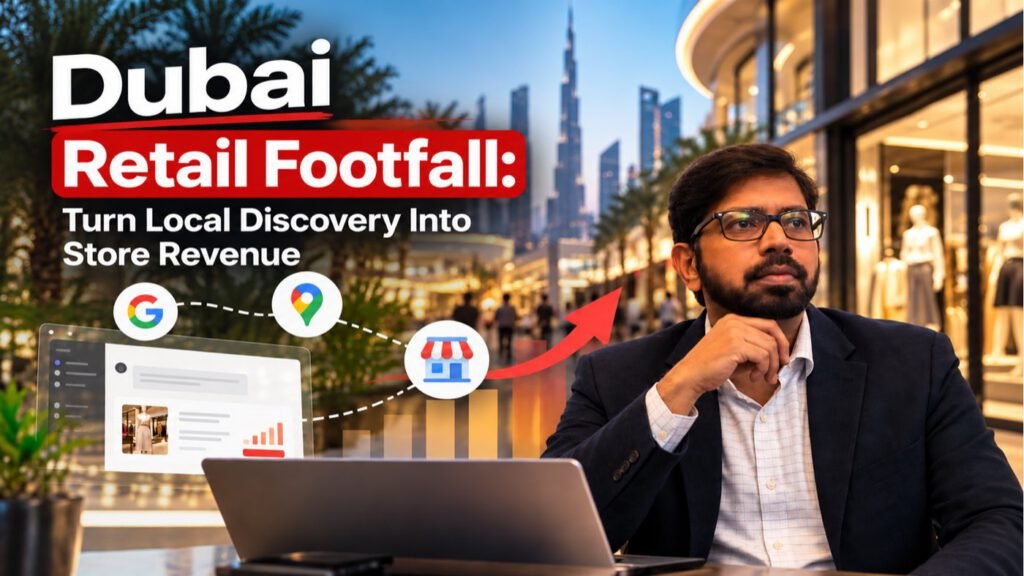
A click is not a customer. A store visit is not automatically revenue. For retailers in Dubai, the job is to connect discovery to the till: Discovery → Intent → Visit → Purchase → POS → Revenue.
This page is for operators who already buy Google, Maps or Meta ads and cannot see which activity paid for itself. It is not a traffic-tips list. If your report stops at impressions or direction requests, you know interest — not Dubai retail footfall that became a sale.
What Dubai retail footfall means at the till
Retail footfall is not only a door count. For growth, it is the number of people who discovered you locally, showed buying intent, visited, purchased, and can be tied back to a campaign, offer or location.
A Google Maps view or a direction request is a useful signal. It is not a sale. The useful loop is:
- Create an offer or message for one store.
- Promote it on Google, Maps, Meta, WhatsApp or another local channel.
- Give the customer a short offer code.
- Record that code at purchase.
- Connect the transaction to POS and reporting.
- Review revenue before you raise the budget.
That is the Swasthe Retail Growth Diagnostic in plain terms. Marketing assumptions become numbers a store manager can argue with.
Why location matters more than most campaigns assume
Dubai is not one retail market. A shop in Karama does not share a journey with Jumeirah, Deira or Al Barsha. People arrive by metro, taxi, car or on foot. A pharmacy sells convenience. A cosmetics counter sells discovery and stock. A café has a morning pattern. A gift shop may peak in the evening.
A city-wide campaign can look busy and still send little useful demand to one unit. Ask three questions before you spend:
- Who is close enough to visit?
- What would make them visit today?
- Can the store serve them when they arrive?
The third question is the one most media plans skip.
Google Maps is part of the storefront
For a physical retailer, Google Business Profile is not an SEO extra. It is the digital door. If hours, photos or the pin are wrong, the customer experience has already failed. The tools to edit that listing sit on Google Business.
Review these regularly:
- Opening and closing hours
- Holiday and seasonal hours
- Phone number
- Business category
- Current store photographs
- Parking and entrance notes
- Products or services actually available
- Location details
Local discovery only works when the listing is trustworthy. Pair Maps work with Google Business Profile and social listing hygiene, not a separate “brand” campaign that contradicts the hours on the door.
Turn local offers into measurable visits
The simplest bridge from ad to till is a short offer code. The point is not a complicated coupon scheme. The point is one identifier that can travel from the channel to the POS.
Example: a cosmetics retailer in Karama promotes one SPF SKU with one code. The same code appears in Google ads, Maps, WhatsApp and social. The cashier records it. You now have a transaction, not a click.
- Avoid long codes and rules cashiers cannot remember.
- Keep the offer easy to understand, redeem and measure.
- Do not create extra work for the floor team.
If you cannot name the SKU and the code in one sentence, the campaign is not ready.
What should retailers measure?
Impressions have a place. They should not be the scorecard for a physical store.
| Stage | What to measure |
|---|---|
| Discovery | Search and Maps visibility |
| Interest | Calls, clicks and direction requests |
| Visit | Identified or coded store visits |
| Conversion | Transactions |
| Revenue | Sales generated |
| Basket | Average transaction value |
| Product | Items or categories purchased |
| Attribution | Revenue linked to campaign or offer |
| Operations | Stock-outs and fulfilment issues |
| Profitability | Contribution after discounts and payment costs |
Campaign A can win on clicks. Campaign B can win on 40 identifiable baskets. Traffic is an input. Revenue is an outcome.
Stock availability and staffing are part of marketing
There is little value in advertising a product the cage does not have. The ad report can still look “successful” while the store tells a different story.
Before you promote a product, confirm:
- It is available — including the advertised variant
- The price is correct
- The promotion is loaded in the POS
- Staff can explain the offer
- The store can handle the expected demand
If a campaign hits the busiest hour, staffing has to match it. If the product needs explanation, someone on the floor must be ready. Marketing does not end at the door. The same ops truth shows up when online orders hit a store that still picks from the till queue.
From first visit to repeat customer
The first transaction is only the start. Loyalty, WhatsApp, reviews and reorder reminders can raise the value of that visit — after you can identify the sale. Do not slow checkout to capture data you will not use. Do not build a loyalty programme before the till can record the offer code.
The revenue attribution problem
Most retailers know spend, clicks and direction requests. Fewer can answer: how much revenue did those activities influence?
A complete answer may need POS, offer codes, customer records, locations, products, payments, inventory and campaign data. You do not need perfect attribution on day one. A simple coded offer already beats platform reporting alone. For the weekly view, keep ads, WhatsApp and POS on one sheet — the same idea as a weekly retail report.
One store first. Then scale.
Multi-site groups often want every mall live in week one. Prove the system in one location: one store, one product family, one offer, one campaign, one tracking method. If it holds, copy it. If it does not, find the leak before you multiply it.
A practical 14-day retail growth test
- Days 1–2. Choose one store and one in-stock category.
- Days 3–4. Write one store-level offer and a short identifier.
- Days 5–6. Fix Google Business Profile: hours, phone, photos, pin, products.
- Days 7–8. Launch one local campaign with that message.
- Days 9–10. Check stock, staff and POS redemption.
- Days 11–12. Review coded transactions, basket and category mix.
- Days 13–14. Keep, change or stop based on the store, not only the ad platform.
What to stop measuring in isolation
Clicks and reach are fine as inputs. Do not celebrate them if the SKU was out of stock, the store was hard to find, the offer could not be redeemed, staff were unprepared, transactions could not be identified, or margin disappeared in the discount.
As the retailer grows, marketing, POS, inventory, payments and customer records have to talk to each other. Otherwise growth adds complexity instead of control. That is the Connect stage of Audit → Build → Connect → Grow.
A newer ad surface does not change the loop. If you test ChatGPT Ads for UAE retailers, the hint still has to name a branch that can serve the visit. Trust breaks when the door does not match the ad — that is retail authenticity in the UAE. If the visit ends on a card, settlement still has to match the till: online payment gateways in the UAE.
FAQ: Dubai retail footfall
Is a Google Maps direction a store visit?
No. It is intent. Count a visit when someone arrives, and count revenue when the till records a related transaction.
Do I need a complicated attribution stack?
No. Start with one offer code and one store. Add systems when the manual loop is trusted.
Should I run the same offer across all Dubai malls?
Not first. Catchment, stock and staffing differ. Prove one unit.
Where does Swasthe sit?
We connect local discovery to store operations and reporting — including ElintOm when POS and marketing numbers disagree. Request a Retail Growth Audit when the leak is named.
Sources
- Google Business — hours, pin, phone and photos. Recheck the live listing before you promote it. This page is not a product manual.
Author
Written by Swasthe editorial. Swasthe Middle East LLC helps UAE retailers connect local marketing with POS, inventory and revenue reporting. Offices in Sharjah (Bin Rasheed) and Dubai International City.
Published: 26 September 2026. Last reviewed: 28 September 2026. Review again within 6–12 months, or sooner if Maps or local-ad products change.
Swasthe on LinkedIn · About Swasthe · Retail Growth
Want to find where Dubai retail footfall is leaking? Bring one location, one offer and last month’s stock sheet to a Swasthe Retail Growth Audit.