

















































A retail technology stack in the UAE is the set of systems that take a product from a bin to a paid sale and a next visit: the till, the stock ledger, the commerce channel, payments, the customer record and the courier. The useful question is which system owns which job, and which jobs are still done in WhatsApp and Excel.
Growing retailers usually meet this question while comparing software. POS, ERP, CRM, Shopify, a marketplace login and a loyalty app arrive as separate proposals. Each proposal is locally true. Together they can still leave Saturday with two stock counts and three customer lists.
What belongs in the stack
On a UAE shop floor the stack has to survive mall hours, 5% VAT on the receipt, Arabic and English on the shelf, and at least one channel that is not the counter. A practical map, in the order a sale actually happens:
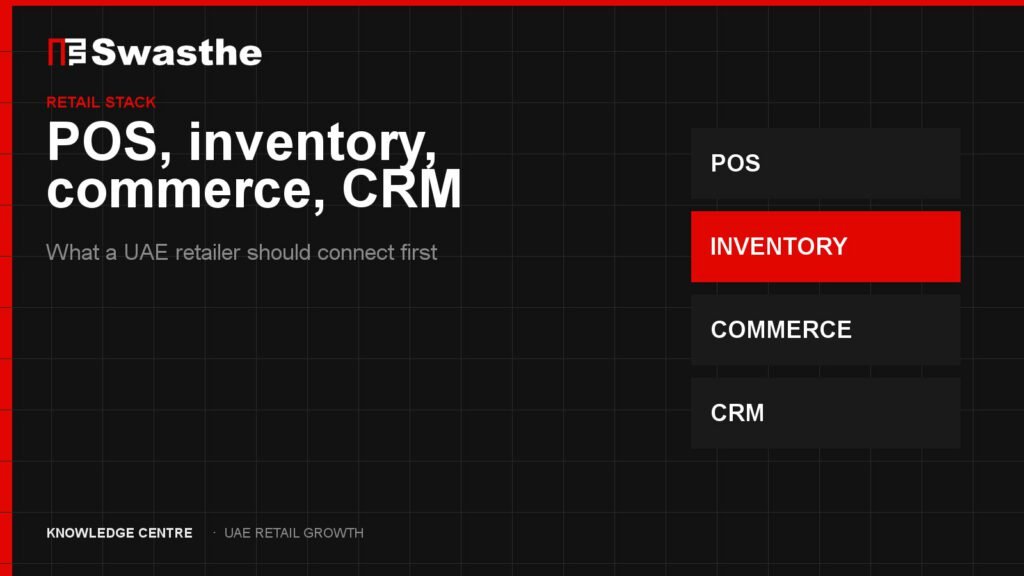
- POS. The bill, the return, the cashier and the receipt.
- Inventory. On-hand, available-to-sell, transfers, purchase and the warehouse bin.
- Commerce. The website, usually Shopify, plus Amazon.ae and Noon when those channels sell the same SKU.
- Payments. The terminal, the online capture and the payment link. Swasthe’s payment partner is uTap.
- Customer layer. WhatsApp, a CRM or marketing automation tool, and loyalty.
- Fulfilment. Pick location, pack bench and the courier.
ERP language shows up when purchasing, finance and multi-branch stock need a heavier ledger than a single-counter till. That does not mean every pharmacy or cosmetics brand should buy an ERP before the till and the website share one available number. The decision order is in the same family as POS software checks for UAE retail.
What each system actually owns
POS owns the moment money and goods change hands in the store. A capable till prints a VAT receipt, knows the cashier, takes a return and can see a customer. It does not, by itself, decide what Amazon.ae may sell tonight.
Inventory owns quantity and location. Available-to-sell is on-hand minus what is already promised to a paid order and what is in transit between Sharjah and Dubai. A spreadsheet updated on Thursday is a memory, not a ledger.
Commerce channels own the shopfront: catalogue, price, content and the online checkout. Shopify can hold locations and quantities. Amazon.ae and Noon are separate shopfronts with their own orders. A channel is a place to sell. It becomes the warehouse only if you deliberately make it the stock system of record and every other channel obeys it. Many UAE retailers have not done that, so the site and the shelf drift.
CRM and marketing automation — Zoho, HubSpot or another tool — own pipelines, campaigns and, when connected, segments. They do not own the bin. A useful architecture observation: a CRM that never receives the till receipt becomes a second customer list. That is not a claim that those products cannot integrate. It is what happens when nobody connects them. The till-versus-stock cut is the next article: POS versus inventory management software.
Where each option fits, and where it does not
Buy or keep a POS when the leak is queue time, returns, VAT receipts or cashiers who cannot see today’s price. A new till does not fix a warehouse that still counts on paper.
Buy or keep inventory depth when you have more than one stock location, transfers, or a website that oversells. A stock module that the cashiers refuse to open is furniture.
Keep Shopify when it is the brand site and the checkout you are willing to maintain. Add Amazon.ae or Noon when those marketplaces already have the demand. Do not add a channel in the same month you discover the Marina shelf and the site disagree. Channel demand is a Grow step. The marketplace path, once stock is true, sits on marketplace growth.
Add a CRM when follow-up is the named leak: enquiries die in personal WhatsApp, and you can already see purchases. Adding a CRM while the receipt stays on the till only creates a cleaner list of strangers.
No option here is the winner for every UAE retailer. A two-counter clinic pharmacy and a multi-branch beauty chain do not need the same depth on the same day. They do need the same honesty about which number is allowed to sell.
Four logins and two stock truths
The gap no single product closes by existing is the agreement between them. This is an architecture observation.
A retailer can own a modern till, a Shopify plan, a Noon seller account and a CRM trial, and still do this on a Saturday: the site sells a unit the Sharjah branch has, the Dubai mall counter sells the last display unit, Noon ships a cancellation on Monday, and the CRM emails a replenishment offer for a SKU that is in a returns cage. Four subscriptions. Two, sometimes three, stock truths.
The commercial centre of the stack is the connection: till, inventory, commerce, payment status, customer and courier. ElintOm is one retail operations platform in that ecosystem. Its published scope covers multi-store POS, inventory, warehouse, orders, CRM, loyalty, WhatsApp follow-up, and Shopify, Amazon, the website and in-store sales in one order queue. It is not a replacement for Amazon, Noon, Shopify or a courier, and it is not “better than” a CRM. Noon is a UAE marketplace many retailers sell on; ElintOm’s public pages name Shopify and Amazon rather than Noon, so treat Noon stock as a channel you must reconcile, not as a connector you can assume.
What to connect first
Sequence the work. Audit the disagreement, build the commerce path that can take payment, connect the ledger, then grow demand.
- Pick five fast SKUs. Write the count on the shelf, on the till, on Shopify and on any marketplace.
- Decide which system is allowed to say “available.” Every other screen reads that number or updates it in the same day.
- Connect payment status to the pick list so a paid order is pickable. See payment gateways.
- Only then add audience, offers or a new marketplace push.
If you are still choosing what the till owns versus what stock owns, go to POS vs inventory management software. If the counts already disagree and you want that diagnosed against demand and checkout as well, start a Free Growth Audit. The wider method is Audit, Build, Connect, Grow.
FAQ: retail technology stack UAE
What is a retail technology stack?
It is the set of systems that run the sale: POS, inventory, ecommerce or marketplaces, payments, customer follow-up and fulfilment. The stack works when those systems share one available quantity and one paid status.
Do I need ERP, POS or CRM first?
Start from the leak. Queue and receipts point at the till. Oversells and transfers point at inventory. Dead enquiries point at CRM, after the receipt can reach it. A full ERP is a later depth, not the first purchase for every store.
Can Shopify be the whole stack?
Shopify can be the commerce channel and, if you run its POS and locations as the only till, it can hold stock for those locations. A separate mall till, a warehouse and Noon or Amazon.ae still need a rule for whose count is allowed to sell.
Where does ElintOm sit?
As one retail operations platform for till, stock, orders and customers, connected to the commerce channels it documents. It sits beside Shopify, marketplaces, payments and couriers. It does not retire them.
What should I read next?
If the open question is billing versus stock, read POS versus inventory. If the open question is the website and the shelf, read how Shopify should connect to the POS and inventory.