

















































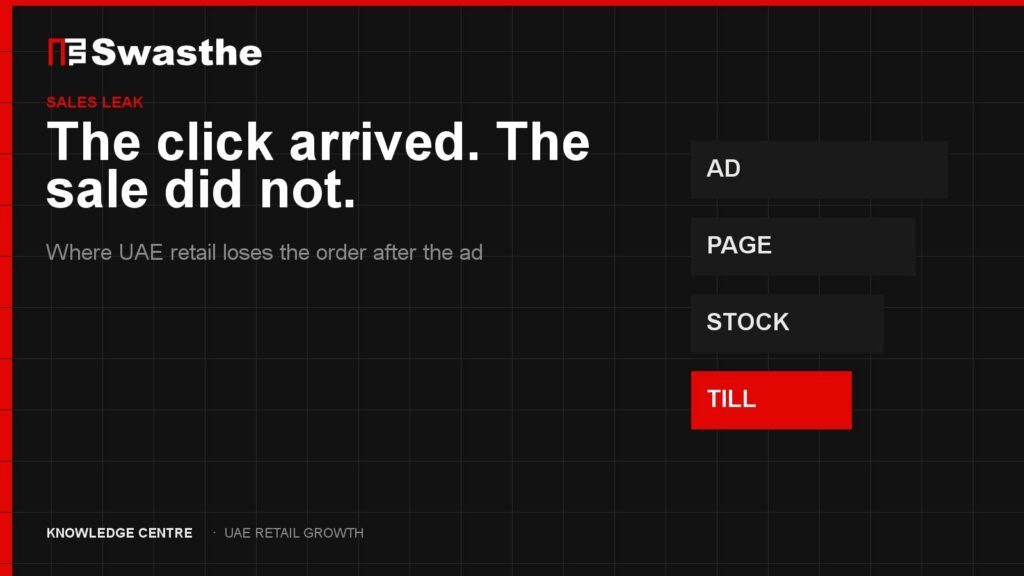
Retail sales problems in the UAE often show up as a quiet till while the ads account still reports purchases. The click arrived. The paid ticket, the packed carton or the return visit did not. That gap is the sales problem worth diagnosing, because raising the budget repeats it.
A Dubai pharmacy, a Sharjah cosmetics counter and a wellness site can share the same pattern: Meta or Google looks efficient, Saturday revenue does not move, and the team argues about creative. The argument is usually in the wrong file. The sale dropped after the click.
The ads account and the till are different scorecards
Ads Manager counts what the pixel was told to count. The till counts captured money and the units that left a bin. When those two numbers diverge by more than a quiet margin, you have a measurement problem and, often, an operations problem wearing a media costume.
A common UAE week looks like this. Prospecting spends AED 12,000. The platform claims 90 purchases. The POS shows 34 paid web orders, 11 pickup no-shows and a WhatsApp thread that closed 15 more sales nobody attributed. Finance sees card settlements that match neither dashboard. Everyone is “right” inside their own login. The retailer is still short.
This is an architecture observation. It is not a claim that Meta or Google cannot track a real purchase. It is what happens when the conversion event, the payment capture and the till ticket are three different events. The repair path for a broken pay step is in why ads fail on a broken checkout.
Four places UAE retail sales actually drop
Walk one order. Do not average the month until you have watched five.
- The page. The ad names a shade, a size or a same-day promise the product page does not repeat. The shopper leaves before checkout. VAT-inclusive price on the ad and ex-VAT price on the page is enough to kill a mall-Wi-Fi session.
- The stock. The site says available. The shelf that serves that emirate sold the last unit at lunch. The order becomes a cancellation or a “we will call you” WhatsApp.
- The payment. Apple Pay dropped after a theme change. 3-D Secure loops. A guest checkout asks for an account. Staff finish the sale on a personal payment link, so the ads pixel and the merchant file disagree.
- The follow-up. The customer paid and left. Nobody tied the receipt to the chat, so the next visit is treated as a new stranger and the repeat never gets asked for.
Each drop has a different owner. A new audience will not fix a personal payment link. A new landing page will not fix a Noon listing that still shows a unit the till sold.
Stock and marketplace cancellations
Retail sales problems that look like “ads stopped working” are often stock problems that started the week the catalogue went live on a second channel.
Picture a supplement brand in Al Quoz. The Shopify quantity is 8. The Marina till shows 3. Amazon.ae still has the parent SKU available because the last feed ran on Thursday. A Google ad sends a buyer to the site. The site takes the money. The packer walks a bin that is empty. The refund WhatsApp goes out on Sunday. The ads account still shows a purchase. The customer remembers a cancellation.
That is one SKU with three available-to-sell numbers. The commercial repair is connection, described in Shopify, POS and inventory and in omnichannel retail across store, Shopify, Amazon and Noon. Until those numbers collapse to one, every extra click has a chance of becoming a refund.
Checkout and paid status
Payment has to reach the pack bench as a status, not as a rumour. If the gateway captured the card and the order queue still says pending, the rider waits or the branch refunds a sale that was real. Compare gateways by that handoff in online payment gateways in the UAE. Swasthe’s payment partner is uTap: the card on the site, the terminal and a WhatsApp payment link should share one merchant path so Saturday finance is one file.
Test this yourself. Buy one SKU on an iPhone. Pay with a wallet. Confirm the till or the order queue shows paid before anyone picks. If it does not, pause prospecting. You are buying refunds.
Follow-up that never sees the purchase
Some “lost sales” are second sales that never got asked for. The first purchase happened. The WhatsApp number sat in a chat. The CRM, if there is one, has an email from a newsletter. The till has a phone number on the receipt that nobody exported. Three lists, one customer, no repeat.
A retail sales problem at 60 days is often this gap, not a tired offer. Connect the receipt to the conversation before you brief a win-back campaign. The map is WhatsApp, CRM and the POS.
Name the leak before you change the creative
Swasthe’s order is Audit, Build, Connect, Grow. Retail sales problems sit in Audit. Grow — more ads, more marketplace deals, more posts — comes after you know which of the four drops is live.
For one week, keep a simple sheet on the busiest branch:
- Ad clicks and spend.
- Paid web or WhatsApp orders that match a settlement.
- Cancellations caused by stock.
- Payment failures.
- Repeats you can prove from a till receipt.
If row two is far below what the ads account claims, you do not have a creative drought. You have a scorecard that is counting the wrong event. If row three is the large number, the leak is stock. If row four is the large number, the leak is payment. If row five is zero and row two is healthy, the leak is follow-up.
The 25 checks that sort those piles are the UAE retail growth audit. The categories themselves are on revenue leaks.
What a retailer should do next
Pick the largest row and repair that path for five real orders. Then, and only then, put spend back. If you can name the row, start a Free Growth Audit so the next repair is sequenced — page, till, stock or follow-up — instead of another media test. If you cannot name it yet, stay on revenue leaks and the 25-check list. Retail growth services come after that diagnosis, on retail growth, when demand really is the remaining leak.
FAQ: retail sales problems UAE
Why are retail sales down if my ads are still getting clicks?
Clicks measure attention. Sales measure a paid ticket you can pick and, later, repeat. The drop is usually stock, checkout, payment status or a follow-up that never sees the receipt.
Should I switch from Meta to Google?
Switching platforms repeats the same path. Fix the page, the paid status and the stock number first. Then choose the channel that matches how your customers already search or scroll.
Can a slow website cause a sales problem even with a good offer?
Yes. A hero that will not load on mall Wi-Fi never reaches checkout. Treat speed as part of conversion, in the same week as the wallet test.
What if WhatsApp is closing the sales the site loses?
Count those chats as a separate line. If recovered chats exceed paid web orders, the site is the bottleneck. Give staff a payment link on the same merchant account, and record the customer against the till.
When is it rational to spend more?
When five consecutive paid orders match the ad conversion, the settlement and the bin, and you know which leak you already closed. The checklist for that decision is the UAE retail growth audit.