

















































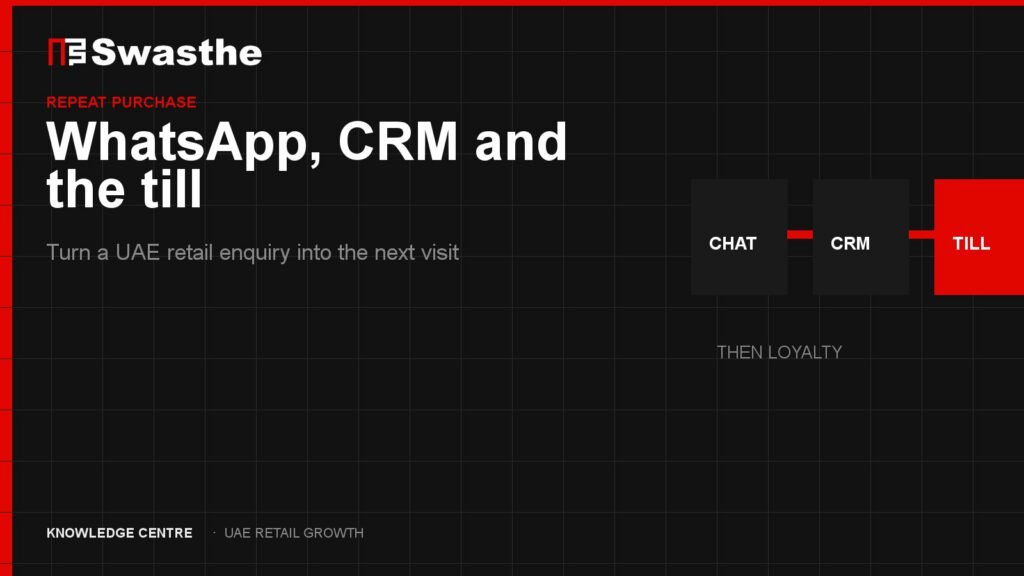
CRM for retail in the UAE fails in a specific way: WhatsApp has the conversation, a CRM has a contact, and the POS has the receipt, and none of them is sure they are the same person. Repeat purchase then depends on a staff member who remembers a face. That does not survive a second branch or a day off.
The commercial question is not which CRM has the longest automation menu. It is whether an enquiry, a purchase and the next offer share one customer. If they do not, you are funding three lists.
Three lists, one Saturday customer
A shopper messages the store WhatsApp about a shade. Staff reply from a personal phone because the shared inbox is not the habit yet. She visits Dubai Mall, buys at the till, and gives a different mobile number for the VAT receipt. Two weeks later a CRM email — built from the Shopify newsletter — offers her a routine she already bought. She ignores it. The brand concludes “CRM does not work for retail.”
The tools may be fine. The purchase never joined the conversation. This is an architecture observation, not a claim that Zoho, HubSpot or any other CRM is unable to store a phone number. Those products can own pipelines and campaigns. They learn retail behaviour only when someone sends them the till event.
What WhatsApp, CRM and the POS each own
WhatsApp owns the live conversation: product questions, “is this in Muweilah,” payment links, and delivery updates. In the UAE it is often the real service desk. It is a poor system of record if the chat dies when one supervisor leaves.
CRM owns the relationship you intend to continue: who enquired, what was promised, which campaign they came from, and the next task. It fits when enquiries are being lost and you already know a human must follow up. It does not fit as a substitute for the shelf. A pipeline stage called “customer” with no receipt attached is a hope.
POS owns the paid fact. What was bought, in which branch, at what VAT-inclusive price, and whether loyalty points moved. A retail CRM that cannot see this fact will keep marketing to people as if the store does not exist. The loyalty side of that receipt is the POS loyalty programme.
A useful split: the conversation can start on WhatsApp, the campaign can live in a CRM, and the truth of the purchase stays on the till — provided the three exchange the phone number and the ticket. The weekly view of ads, chats and the till together is sketched in the weekly retail report.
Where each fits, and where it does not
Stay on WhatsApp alone only while one counter can still see every chat and every regular. The day a second branch opens, personal phones become lost sales.
Add a CRM when reply time and ownership are the leak: chats sit unread during mall hours, and nobody knows who should answer. Do not add a CRM to “do loyalty” if points never print on the receipt. Loyalty that is not on the till is a second programme customers will not trust.
Keep the POS customer record when the purchase is in-store and the phone number is captured with consent at the counter. Push that event to WhatsApp and to the CRM. Pulling the CRM into the till as the only database, while cashiers skip the lookup because it is slow, recreates the split.
Zoho and HubSpot remain reasonable CRM and automation choices for many UAE businesses. ElintOm is not a winner over them. ElintOm is a retail operations platform whose public scope includes CRM and customer history, loyalty, and WhatsApp follow-up such as abandoned-cart reminders, beside POS and inventory. Use that when you want purchase, stock and the conversation on one operations platform. Use a specialist CRM when marketing automation is the job and you will connect it to the receipt. Both can be true. Neither replaces the shelf.
Follow-up without the receipt
The gap that costs the second sale: a message goes out that ignores what the person already bought. You recommend a product they returned. You offer a new-customer code to someone who purchased yesterday in Sharjah. You ask a pharmacy customer to repurchase a SKU the till knows they bought 10 days ago, on a cycle of 30.
Retail repeat is a timing problem tied to a real SKU. The data for that timing is the receipt. WhatsApp is the channel many UAE customers will actually read. The CRM is the place you might design the rule. If the receipt never arrives, the rule is a guess. Connect first. Then Grow — the offer, the loyalty point, the replenishment note.
There is a clinic version of WhatsApp CRM on this site for appointment businesses. Retail is different: the “appointment” is often a SKU leaving a bin. Keep the retail design on the receipt. Service-business chat handling is a separate path.
What a repeat looks like when the receipt arrives
A two-branch pharmacy in Sharjah and Dubai was answering WhatsApp well and still flat on repeats. Chats were fast. The CRM had 4,000 contacts from a leaflet QR. The till had the real buyers. A supervisor pulled 30 receipts from a Tuesday and tried to find those mobiles in the CRM. Eleven matched. Nineteen were only on the receipt, including the people who had asked on WhatsApp the same morning and then paid at the counter with a different number.
They changed one habit before they changed software. The cashier asked for the WhatsApp number already on the chat, and the paid ticket — SKU and branch — was written back to that chat’s contact the same day. Thirty days later the replenishment note for a 30-day vitamin went only to people whose till date matched the cycle. Replies came from customers who recognised the product, not from a blast. The CRM did not become the hero. The receipt did. The CRM finally had something true to automate.
What to connect, in order
- One shared WhatsApp inbox for mall hours. Personal phones stop being the system of record.
- Capture a mobile number on the till with a clear reason: receipt, loyalty, or delivery.
- Send the paid ticket — SKU, branch, date — to the customer profile the follow-up uses.
- Write one replenishment or loyalty rule off that ticket. Measure repeats at 60 days, by branch.
- Only then increase the campaigns that ask people to come back.
If you cannot tell whether the leak is unanswered chats, a CRM with no receipts, or loyalty that never hits the till, start a Free Growth Audit. The categories of leak sit on revenue leaks. If the receipt is the missing piece and you are designing points next, continue to POS loyalty and the loyalty programme page. The stack around CRM is in the retail technology stack.
FAQ: CRM for retail UAE
What is a retail CRM?
A customer record that can see enquiries and actual purchases, so follow-up refers to what the person bought, in which branch, and when they are likely to need it again.
Is WhatsApp a CRM?
WhatsApp is the conversation. It becomes part of a CRM when the chat, the phone number and the till receipt stay attached after the staff member changes shift.
Do I need HubSpot or Zoho for a store?
You need them if you want their automation and you will feed them the receipt. You do not need them as a substitute for POS and inventory. Compare fit. Do not expect either CRM to count the bin.
When should loyalty live on the POS?
When the point or the reward must be true at the moment of payment. A loyalty app that does not know the ticket will argue with the cashier in the queue.
What is the next step if chats and the till disagree?
Start a Free Growth Audit so follow-up is separated from stock and checkout. If you already know the gap is repeat purchase at the till, read the POS loyalty article.