

















































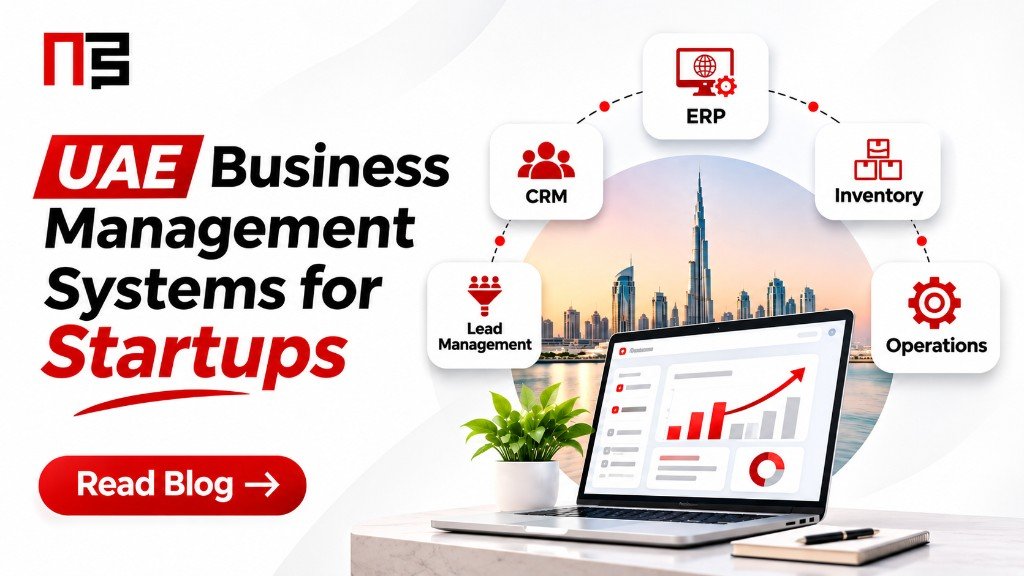
Business management systems in the UAE connect the records a company uses every day: leads, customers, stock, orders and the work between them. For a startup, the useful question is which part of the business needs a proper system first.
Starting a business in the UAE is relatively straightforward.
Running it efficiently as it grows is harder.
A startup may begin with WhatsApp, spreadsheets, email and a few cloud tools.
That can work when the team is small.
The problems usually begin when the business starts adding:
- More customers
- More employees
- More enquiries
- More products
- More orders
- More locations
- More approvals
- More reporting
At that point, the question is no longer:
“Which software should we buy?”
The better question is:
“What part of the business needs a proper management system first?”
This is where business management systems become important.
For UAE startups, the answer may involve lead management, CRM, ERP, inventory, operations, workforce management or a custom workflow.
The right system depends on how the business actually works.
Reviewed 16 November 2026 by Swasthe Middle East LLC. How the company approaches this work is on Why Swasthe.
Why this matters for UAE startups
The UAE continues to invest heavily in entrepreneurship, SMEs and digital transformation.
The National Agenda for Entrepreneurship and SMEs includes digital transformation as one of its core themes, alongside ease of doing business, innovation, funding, business support and human capital.
Dubai is also actively strengthening its startup ecosystem. Dubai Founders HQ, launched under the Dubai Economic Agenda D33, is designed to support founders, investors and SMEs, with goals that include enabling 400 SMEs to grow by 2033.
The broader direction is clear.
Businesses are expected to become more digital.
But digital does not mean adding more disconnected apps.
It means building a business structure where information moves properly between teams, customers and operations.
What is a business management system?
A business management system connects the information and workflows a company depends on every day.
Depending on the business, that may include:
- Leads
- Customers
- Sales pipeline
- Inventory
- Purchasing
- Orders
- Production
- Projects
- Operations
- Employees
- Attendance
- Approvals
- Reports
- Dashboards
- Ecommerce
- Payments
The purpose is not to digitise everything for the sake of technology.
The purpose is to reduce manual work, improve visibility and give management better control.
For a startup, that usually happens in stages.
You do not need every module from day one.
You need the system that solves the most expensive operational problem first.
Lead management: when enquiries start getting lost
Many startups begin by managing leads through:
- Phone calls
- Meta campaigns
- Google Ads
- Spreadsheets
This becomes difficult surprisingly quickly.
A business may receive 50 or 100 enquiries in a month and still have no reliable answer to:
- Who followed up?
- When was the last contact?
- Which salesperson owns the lead?
- Which source generated it?
- What stage is the opportunity in?
- Why was the deal lost?
- Which salesperson is converting best?
A lead management system creates structure.
Typical capabilities include:
- Lead capture
- Lead assignment
- Follow-up reminders
- Pipeline stages
- Sales ownership
- Notes and activity history
- Conversion tracking
- Lead-source reporting
For businesses such as real estate, contracting, healthcare and professional services, lead management can often be the first business system worth implementing. Retail teams that already sell at the till can see the same follow-up gap in WhatsApp, CRM and POS.
CRM: when customer information is scattered
Lead management deals with opportunities.
CRM manages the wider customer relationship.
As a business grows, customer information often becomes spread across:
- Invoices
- Spreadsheets
- Individual employee phones
- Accounting software
- Ecommerce systems
A CRM gives the business one customer record.
That record can include:
- Contact details
- Sales history
- Purchase history
- Enquiries
- Follow-ups
- Notes
- Service history
- Communication
- Open opportunities
- Customer status
This matters because the customer should belong to the business, not to one salesperson’s phone.
For growing UAE startups, CRM is often one of the first steps toward reducing dependence on individual employees.
ERP: when different parts of the business need one system
ERP becomes relevant when a company has several operational functions that need to work together.
For example:
- Sales
- Purchasing
- Inventory
- Orders
- Billing
- Operations
- Reporting
Instead of each function maintaining its own information, ERP creates one connected operational layer.
For a startup, however, ERP should not be treated as an automatic requirement.
A small services company may not need a full ERP.
A distributor with hundreds of products and purchase orders might need it much earlier.
A manufacturer may need production and inventory functionality from the beginning.
The important question is:
Does the business need one connected operational record?
If yes, ERP becomes more valuable. For a retailer, that question usually starts with the till, the stock ledger and the sales channel, which is the map in the UAE retail technology stack.
Inventory management: when stock becomes difficult to trust
Inventory becomes a serious operational problem once a company sells:
- Multiple products
- Across several channels
- From more than one location
- Through ecommerce
- Through marketplaces
- Through retail outlets
Common issues include:
- Stock-outs
- Overstock
- Incorrect stock counts
- Duplicate spreadsheets
- Delayed updates
- Products available online but unavailable physically
- Poor purchasing decisions
Inventory management software helps create one view of stock.
That can include:
- Stock by location
- Purchasing
- Goods received
- Transfers
- Reorder levels
- Product movement
- Barcode management
- Sales deductions
- Stock valuation
For ecommerce and retail startups, inventory accuracy directly affects customer experience. The practical checks are in inventory management software for UAE retailers and how Shopify should connect with POS and inventory.
For manufacturers and distributors, it affects production and cash flow. A store that sells the same SKU at the counter and online still has to decide whether the till or the stock ledger is allowed to say what is available.
Operations management: when work needs to move through a process
Some businesses do not mainly sell products.
They manage work.
Examples include:
- Contractors
- Maintenance companies
- Facilities management
- Home healthcare
- Professional services
- Installation companies
- Project businesses
Their challenge may be:
- Assigning work
- Tracking status
- Managing approvals
- Following tasks
- Coordinating teams
- Monitoring deadlines
- Reporting to management
Operations management software gives the business a structured workflow.
A typical process might be:
- Enquiry
- Quotation
- Approval
- Job creation
- Task assignment
- Execution
- Completion
- Billing
- Reporting
Without a system, these steps often live across WhatsApp, email and spreadsheets.
That makes management visibility difficult. Where the missing step is a workflow the current tools cannot cover, that is a custom software question, not a reason to buy another generic app.
Manufacturing systems: when production and inventory need to connect
Manufacturing requires a different level of operational control.
A growing manufacturer may need visibility across:
- Raw materials
- Production planning
- Work orders
- Production status
- Inventory
- Purchasing
- Finished goods
- Dispatch
- Team activity
- Reporting
This is why manufacturing systems should not be treated as simple inventory software.
The real value comes from connecting production activity with stock and orders.
For UAE manufacturing businesses, especially SMEs, the system needs to reflect the actual workflow rather than forcing a generic process. Swasthe treats that as a scoped manufacturing engagement beside ERP, not as a feature that can be assumed from a retail inventory module.
Contractor management: when projects become difficult to control
Contracting businesses often have several activities happening at once:
- Lead generation
- Site visits
- Quotations
- Projects
- Tasks
- Approvals
- Subcontractors
- Materials
- Employees
- Billing
- Management reporting
The business may already have accounting software.
That does not mean operations are controlled.
A contractor management system should help answer:
- Which jobs are active?
- Who is responsible?
- What tasks are delayed?
- Which approvals are pending?
- What materials are required?
- What has been completed?
- What can be invoiced?
This is where workflow-based business systems can create real operational value. The day-to-day handoff still belongs with operations management.
Workforce management: when attendance is no longer enough
Many businesses begin workforce management with attendance.
But as the company grows, the requirement often becomes broader.
Management may need:
- Attendance
- Shifts
- Team allocation
- Employee records
- Site assignment
- Working hours
- Task activity
- Approvals
- Performance reporting
Workforce management should therefore connect employees to the work they are actually responsible for.
For contractors, healthcare companies, retail groups and manufacturers, this becomes particularly important when teams operate across multiple locations.
Custom software: when the workflow does not fit standard software
Not every business problem needs custom software.
In fact, most startups should avoid building custom software too early.
Standard platforms are usually faster and less expensive.
But custom development becomes useful when:
- The company has a genuinely unique workflow
- Existing software requires too many workarounds
- Several systems need to be integrated
- Manual steps remain despite using software
- The business has grown beyond generic tools
- A critical process needs to be automated
The right approach is usually:
Use standard modules where they fit.
Configure where possible.
Integrate when necessary.
Build custom workflows only where the business genuinely needs them.
This reduces both cost and implementation risk. The map of those choices sits on Business Management Systems UAE.
Why startups often buy too many disconnected tools
A common startup pattern looks like this:
- CRM from one company
- Inventory from another
- Accounting elsewhere
- Attendance in another app
- WhatsApp separately
- Ecommerce separately
- Reporting in spreadsheets
Each tool may work.
The problem is the gaps between them.
- Customer information does not match.
- Stock updates are delayed.
- Employees copy information manually.
- Reports require several exports.
- Management cannot see the whole business.
This is why the next phase of software adoption is increasingly about connected platforms and workflows. The same gap, seen from a retail counter, is described in ElintOm versus scattered tools.
Large ERP vendors are also moving in this direction.
For example, Oracle NetSuite’s 2026 UAE announcement emphasised AI-centric ERP, conversational intelligence, agentic workflows and the automation of repetitive and complex business tasks. That is a description of NetSuite’s direction. It is not a claim about any other product.
The larger trend is clear.
Business software is moving from static databases toward systems that actively help coordinate work.
How do business management systems work together?
A business management system connects the information and workflows a company uses to manage its customers, sales, inventory, orders and operations. For UAE startups, this may involve CRM, ERP, inventory management, workforce workflows and business reporting. The appropriate combination depends on the company’s operational requirements.
Customer and lead management. Enquiries, the customer record and the history of what was said and sold.
- Enquiries
- CRM
- Customer history
Business operations. The work that turns a sale into something the team can fulfil.
- Orders
- Inventory
- POS, where the business sells in a store
- Workflows
Management and reporting. The view a founder uses to decide what needs attention.
- Analytics
- Visibility
- Decisions
Connecting a store, ecommerce and the customer conversation is the subject of omnichannel retail in the UAE. The sequence for that work is Audit, Build, Connect, Grow, set out on the framework.
CRM, ERP and inventory compared
CRM, ERP and inventory software answer different questions. Buying one does not close the job of the other.
| System | What it owns | When a UAE startup usually needs it | What it does not replace |
|---|---|---|---|
| CRM | The customer record: who they are, what was discussed, what they bought, and who should follow up | Customer information lives in WhatsApp, inboxes and individual phones | Stock, purchasing, production or job status |
| ERP | One operational record across sales, purchasing, inventory, orders, billing and reporting | Separate lists make it hard to coordinate transactions and reports | A reason to install a full suite on day one |
| Inventory | Quantity, location, movement, receipts, transfers and what is available to sell | The business sells more than one product, from more than one place, or on more than one channel | The sales pipeline or a contractor’s job workflow |
A services firm can need CRM while a distributor needs inventory first. A retailer often needs the till and the stock count to agree before a separate CRM becomes useful. That is an architecture observation, not a ranking of vendors.
AI will make business systems more important, not less
AI agents are becoming capable of performing more operational tasks.
That can include:
- Following up on leads
- Updating records
- Generating reports
- Checking stock
- Assigning tasks
- Answering internal questions
- Monitoring workflows
- Flagging exceptions
But AI needs structured business data.
An agent cannot reliably manage a business if:
- Customers exist in one spreadsheet
- Inventory exists somewhere else
- Operations live in WhatsApp
- Tasks are tracked manually
- Employee records are incomplete
This is why business systems become even more important as AI adoption increases.
The system becomes the operating layer.
AI becomes an intelligence and automation layer on top of it.
The UAE’s broader digital policy direction also supports greater use of integrated data and AI systems. In June 2026, Sheikh Mohammed bin Rashid approved a federal Artificial Intelligence and Data Authority to consolidate public data, artificial intelligence and digital government into one national body. That is a government mandate. It is not a private-sector software requirement.
For startups, the lesson is practical:
Before adding AI agents everywhere, make sure the underlying business records are structured. Where a repeating step is already reliable, automation belongs on custom business software or on the business systems workflow that already holds the record.
How should a UAE startup choose the right system?
Do not start with a software feature list.
Start with the business problem.
Ask:
- Where are we losing the most time?
- Where are errors happening?
- What information can management not see?
- Which process depends too heavily on one employee?
- Where are customers getting delayed?
- What needs manual follow-up every day?
- Which spreadsheets are becoming difficult to maintain?
Then prioritise.
A startup with poor sales follow-up may need lead management first.
A distributor may need inventory first.
A manufacturer may need production and inventory together.
A contractor may need operations management.
A growing ecommerce business may need CRM, inventory and order visibility.
There is no universal starting point.
What should a business management platform include?
For many growing companies, a practical business platform should be capable of supporting several areas over time.
These may include:
- Lead management
- CRM
- ERP
- Inventory
- Operations
- Manufacturing
- Contractor management
- Workforce
- Reporting
- Ecommerce
- Integrations
- Automation
- Custom workflows
This does not mean implementing all of them immediately.
It means choosing a platform that can grow with the business. It also does not mean one product already contains every item on that list. Some of those areas are verified modules. Others are configured, integrated or built when the workflow needs them.
Where ElintOm fits
ElintOm is Swasthe’s retail and commerce platform for companies that need better control over customers, orders, inventory, ecommerce and reporting. The product site is elintom.io.
The starting point depends on the business.
A real estate company may begin with lead management and CRM.
A contractor may begin with operations and workforce management.
A manufacturer may begin with inventory and production workflows.
A retailer may begin with POS, customers and inventory.
An ecommerce business may begin with orders, customers and stock.
Where standard modules already fit, ElintOm can be configured around the requirement.
Where the workflow goes beyond standard capabilities, integrations or custom development can be scoped around the business.
The objective is not to install more software.
It is to create a clearer operating system for the company.
Those starting points are the business problems. They are not a list of native ElintOm modules. Verified ElintOm capabilities are POS and billing, inventory, customer records and purchase history, loyalty, orders, ecommerce and marketplace connectivity, WhatsApp workflows, and analytics and reporting. A retailer or an ecommerce business can start there.
A pre-sale lead pipeline, manufacturing production, contractor job control and workforce attendance are assessed separately for configuration, integration or custom development. Broader ERP, beyond retail and commerce operations, is a separate scope. Read the boundary on ElintOm and on the matching Business Systems page before treating any of those as included.
A practical starting framework for startups
A simple sequence works well.
First, map the workflow.
Understand how the business currently manages customers, sales, operations, inventory and people.
Second, identify the biggest operational constraint.
Do not implement ten modules because they exist.
Fix the process creating the most risk or wasted time. If the constraint is still unnamed, the leak categories on revenue leaks are a useful check.
Third, configure the right system.
Use standard software wherever possible.
Fourth, integrate existing tools.
Accounting, ecommerce, marketplaces, payments and communication systems may need to remain in place.
Fifth, automate repetitive work.
Only once the core records are reliable.
Sixth, improve over time.
A business management system should evolve with the company.
The goal is better control, not more software
Startups often assume digital transformation means buying more tools.
Usually, the opposite is better.
- Fewer disconnected systems.
- Less manual duplication.
- Better visibility.
- Clearer ownership.
- Reliable data.
- More automation.
- Better decisions.
For a growing UAE company, the right business system should help management answer simple questions quickly:
- What leads are open?
- What customers need follow-up?
- What orders are pending?
- What stock do we have?
- What work is delayed?
- What is the team doing?
- What needs attention today?
When those answers are difficult to obtain, the business has probably outgrown its current way of working.
That is the point where a proper business management system starts creating value.
For retail and commerce, ElintOm is the operating layer to start from, using the verified modules the business needs now. Workflows outside that set are added only when configuration, integration or custom development is the honest scope.
If the next question is which retail systems should share one record, read the UAE retail technology stack. If you can already name the constraint, start a Free Growth Audit.
Sources
- UAE Government: The National Agenda for Entrepreneurship and SMEs. Digital transformation is one of seven themes, with ease of doing business, innovation, business support, funding, human capital and increasing demand.
- Dubai Media Office, 6 October 2025: Dubai Founders HQ, launched under the Dubai Economic Agenda D33, with goals that include enabling 400 SMEs to grow by 2033.
- UAE Government: Dubai Economic Agenda D33
- Oracle, 10 February 2026: NetSuite Next for businesses in the UAE. Cited as that vendor’s stated direction, not as evidence about ElintOm.
- Dubai Media Office, 14 June 2026: establishment of the federal Artificial Intelligence and Data Authority, reporting to the UAE Cabinet.
- Google Search Central: creating helpful, reliable, people-first content
- Google Search Central: SEO Starter Guide
Frequently Asked Questions
What is a business management system?
A business management system is a combination of software, processes and workflows that helps a business manage customers, sales, inventory, operations and reporting. The point is one reliable record of the work, not a longer list of apps.
What business management software do UAE startups need?
UAE startups may need CRM, ERP, inventory, lead management or operations software depending on the business model, team size and the process that is already failing. A services firm and a multi-location retailer do not start in the same place. The options are mapped on Business Management Systems UAE.
What is the difference between CRM and ERP?
CRM manages customer relationships, interactions and sales information. ERP connects broader operational functions such as inventory, purchasing, orders, billing and reporting. One customer record does not, by itself, tell you what is in the warehouse.
When should a startup implement ERP software?
A startup should consider ERP when separate systems and spreadsheets make it difficult to coordinate operational information, manage transactions and keep reporting accurate. A small services company may not need that layer yet. A distributor or a manufacturer often reaches it earlier.
What is inventory management software?
Inventory management software helps a business track stock quantities, product movements, purchases and availability across stores, warehouses and sales channels. For UAE retailers, the practical version of that question is covered in inventory management software in the UAE.
How can businesses automate their operations?
Businesses can automate repetitive activities such as lead assignment, notifications, approvals, order updates, reporting and supported integrations between systems. Automation is useful after the underlying record is reliable. It does not repair a process that still lives in three spreadsheets.
What is the difference between business management software and custom software?
Business management software provides standard capabilities for common processes. Custom software is developed or extended when the workflow does not fit those capabilities, or when two systems that should stay in place need a bridge. Most startups should configure a standard platform before they commission a build.
Can CRM and ERP work together?
Yes. CRM and ERP can share relevant customer, order and operational information through a supported integration. The commercial gain is one view of the customer and the transaction, not a second copy of the same list.
Is ElintOm suitable for UAE businesses?
ElintOm supports retail and commerce operations through POS, inventory, orders, customer records, loyalty, ecommerce and marketplace connectivity, WhatsApp workflows and reporting. Lead pipelines, manufacturing production, contractor projects and workforce attendance are assessed separately for configuration, integration or custom development. See ElintOm.
How can a UAE startup choose the right business management system?
Start with the operational problem that costs the most time or creates the most errors. Review the tools and spreadsheets already in use, decide which record must be trusted, and choose a system that can take the next workflow later. There is no universal first module.
Which answer is still hard to get: open leads, stock, pending orders, or delayed work?
Read next: Business Management Systems UAE · Inventory management software UAE · ElintOm versus scattered tools · Shopify, POS and inventory · Where growth leaks · ElintOm for retail and commerce operations