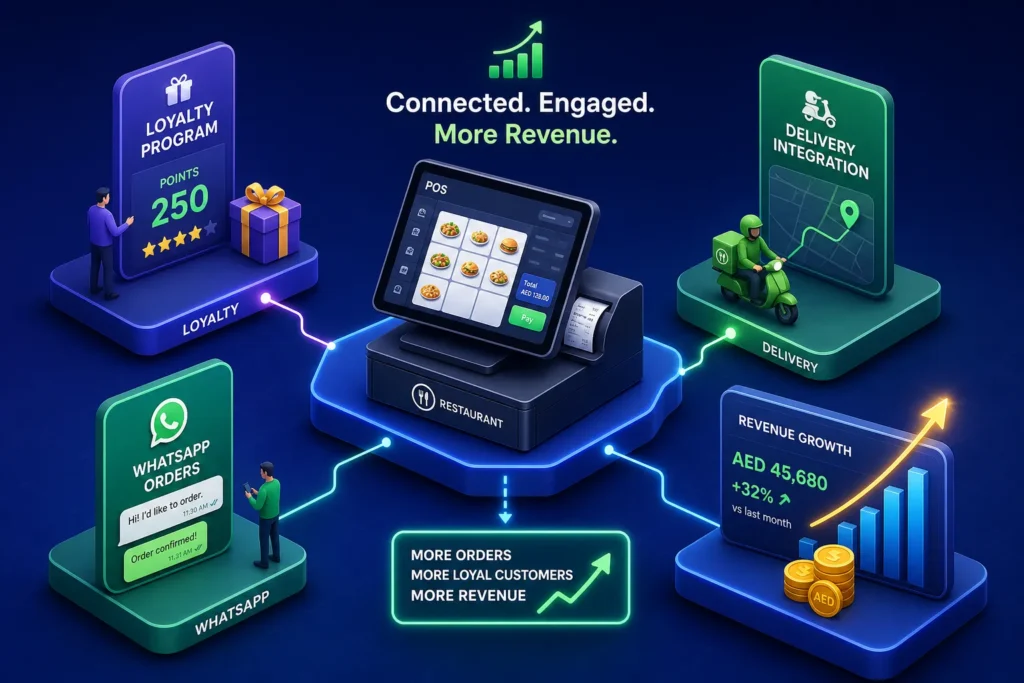
Many UAE restaurant owners are running four systems that don’t talk to each other. A POS that takes orders. A loyalty app with low redemption rates. Three delivery tablets stacked on the counter, each requiring manual re-entry. And a WhatsApp number managed by whoever isn’t too busy to reply. Each piece works in isolation. Together, they bleed revenue every shift.
The central issue isn’t the tools themselves. The right restaurant POS software UAE operators need isn’t a smarter billing system, it’s a connected revenue system. When a POS links properly to delivery platforms, loyalty programs, and WhatsApp automation, it stops being a cash register and starts being the operational layer that grows revenue without adding headcount.
At Swasthe, we work with restaurant and food and beverage operators across Sharjah, Dubai, and the wider UAE. From our operational observations, the same gaps appear repeatedly: disconnected delivery revenue, loyalty data that never informs re-engagement, and inventory decisions made from memory rather than data. This article maps what to evaluate, what outcomes to expect, and how to build a vendor shortlist before you sign anything.
What UAE restaurant POS software must actually handle
Before you evaluate integrations, confirm the core system is built for a UAE operating environment. Generic POS platforms ported into the region often miss critical requirements that become operational problems within the first month.
Menu management, modifiers, and Arabic/English support
A bilingual interface and receipt printing in both Arabic and English are a practical requirement in the UAE, not a preference. Systems like TajerGo and MealNix handle this at the interface level, not just on the receipt layer, which matters when your staff switch between languages during service. Modifier management is equally important: half portions, combo rules, allergen notes, and custom instructions need to be configurable per item and per channel, because a delivery order for a modified dish that is handled differently from its dine-in equivalent creates kitchen confusion that accumulates into errors.
Most operators discover the depth of this problem when they open a second location. What worked on one branch with manual workarounds falls apart at scale. A POS that handles bilingual modifiers correctly from the start removes that friction.
How restaurant POS software UAE handles VAT, delivery and loyalty
UAE restaurant POS software must handle automatic 5% VAT calculation, TRN display on every receipt, and the distinction between simplified and full tax invoices. Simplified invoices apply to standard B2C restaurant transactions, typically under AED 10,000. These require the restaurant’s name, address, TRN, invoice date, item description, and total including VAT. Full tax invoices are required for corporate dining, VAT-registered customers claiming input tax, or sales above AED 10,000. These must include the customer’s name, address, TRN, a sequential invoice number, and a line-by-line VAT breakdown.
The system also needs to export VAT return data for Form 201 filing and support credit notes for refunds and voids. Record retention under UAE VAT law requires keeping transaction records for at least five years. One additional factor to evaluate now: the UAE is moving toward phased e-invoicing, and a POS that can’t export structured invoice data will need replacing sooner than expected.
Offline reliability when connectivity drops
Offline mode is where POS marketing and POS reality diverge most sharply. A full offline-first system stores transactions locally, continues processing orders and payments, and syncs automatically on reconnection without any staff intervention. A partial offline system pauses refunds, reports, and delivery orders the moment connectivity drops. For a UAE restaurant in a busy mall or an older building with inconsistent internet, the difference between these two is a real operational risk during peak service.
Ask any vendor a direct question before signing: does offline mode include payment processing, or just order taking? The answer tells you exactly how much operational exposure you’re accepting.
Why delivery platform integration is where most UAE restaurants lose money
Delivery through Talabat, Deliveroo, and Careem represents a significant revenue channel for UAE restaurants. But most operators run it through separate tablets with manual re-entry into the POS, which means errors, delays, and reporting gaps on every shift.
How aggregator orders connect to a unified POS
There are three integration models. The first is a direct POS connector, where the POS vendor has built a native link to the delivery platform’s API. The second is a middleware hub, such as UrbanPiper, which consolidates multiple aggregator feeds into one stream and pushes orders into the POS. The third is manual entry, which is what most small UAE restaurants default to when no integration exists. The middleware approach is the most realistic path for independent restaurants and small chains, because building direct connectors with every aggregator requires vendor-level API agreements that most POS providers handle on your behalf through a middleware partner.
The correct flow looks like this: an order arrives from Talabat, appears in the POS, routes to the kitchen display system, updates inventory, and records payment. No second device. No transcription. The kitchen sees the order with modifiers intact, and the revenue lands in the same VAT report as every dine-in sale.
The measurable impact of cutting manual order entry
Operators in Swasthe’s network who integrated delivery through a middleware hub report order processing time dropping from roughly two and a half minutes per order to under thirty seconds. Daily reconciliation work shrinks from four to six hours to fifteen to thirty minutes. Order accuracy improves because nobody is transcribing anything between a tablet and a POS screen. Beyond accuracy, the multi-aggregator view surfaces something most operators have never seen clearly: which platform is actually profitable after commissions. That data point alone changes purchasing and promotion decisions.
How WhatsApp and loyalty programs close the repeat-purchase gap
UAE restaurant owners consistently identify WhatsApp re-engagement as valuable. Most haven’t operationalized it beyond a staff member sending manual broadcasts from a personal number. The gap between knowing and building is usually a systems problem, not a strategy problem.
WhatsApp automation tied to the POS transaction layer
A POS-connected WhatsApp setup works through event triggers. An order completes, and a confirmation message sends automatically. Seven days pass without a return visit, and a re-engagement message goes out with a specific offer. A loyalty record shows a customer’s birthday, and an offer follows. This runs through the WhatsApp Business API via a BSP or a POS vendor’s native integration, not a consumer WhatsApp account. Systems like Online eMenu are described as WhatsApp-native, with order flows and kitchen routing built directly into the WhatsApp channel. Others connect through middleware providers like WATI or 360dialog.
The result is a follow-up system that doesn’t depend on staff availability or memory, one that runs entirely on transaction data the POS already captures, typically delivering open rates well above conventional email campaigns.
Building a loyalty loop that drives measurable repeat orders
For UAE food and beverage operators, Swasthe’s operational observations point to a clear hierarchy. Visit-based stamp programs produce the fastest repeat purchases in cafés and QSR environments because the reward feels immediate and the mechanic is easy to understand. Points per spend scales better across mixed check sizes and multi-location brands. Tiered rewards work as a retention layer for premium and status-driven guests, but they perform best when stacked on top of points or stamps rather than used as the only mechanic.
The practical rule: the first reward should be reachable within two or three visits. Early gratification builds habit. Consider what converting 20% of first-time guests into regular monthly visitors means for a restaurant doing 300 covers on a weekend, a meaningful block of incremental covers at your average spend, generated without any increase in marketing cost. The loyalty system isn’t the marketing budget. It’s the multiplier on the marketing you’re already spending.
Multi-branch restaurant POS software UAE: inventory and transfers
For restaurants running two or more locations, or preparing to open a second, inventory is where operational loss hides most quietly. The problem rarely shows up as a single large variance. It accumulates in small over-orders, missed transfers, and purchasing decisions made without consumption data.
Real-time stock visibility across locations
A connected POS inventory layer gives you centralized menu and pricing control, per-branch stock tracking, and the ability to transfer stock between locations without a separate spreadsheet running alongside. The purchasing workflow tightens: the POS flags low stock based on actual consumption, the manager approves a purchase order within the same system, and inventory updates on delivery confirmation. This is the operational difference between reacting to waste after it happens and preventing it before it does.
How linked purchasing and inventory reduces food waste
Consider a UAE restaurant running a rotating daily specials menu without real-time stock visibility. Ingredient orders are based on estimation, which means the kitchen regularly over-orders proteins and under-orders prep items. A cloud POS UAE operators deploy with inventory tracking can surface consumption patterns against sales data, allowing purchasing decisions to tighten materially, with less over-ordering and fewer last-minute gaps, over the first quarter of use. That directly improves food cost margins, which for most UAE restaurants are already under pressure from rising supplier prices and delivery commissions.
How to evaluate, shortlist, and implement the right system for your UAE restaurant
The commercial decision is where most buyers spend the least time on the right questions. Understanding what you need is the first step. Knowing what to ask vendors before signing is what protects you from a costly switch eighteen months later.
The shortlist decision framework for UAE restaurant owners
Start with honest answers to seven questions: How many branches do you currently operate, and how many are planned within two years? Is offline reliability a real operational risk for your location? Which delivery platforms drive meaningful revenue, and are they growing or shrinking as a share of total sales? Do you have a loyalty program, and is it generating repeat visits or just sign-ups? How much time does your team spend on VAT reporting and reconciliation each month? Are you locked to specific hardware, or do you need hardware flexibility? And what is your realistic monthly budget per branch?
On pricing, the UAE market in 2026 gives you a clear range. Entry-level options include TajerGo at AED 99 per branch per month and Luqma POS at AED 149 to 299 per branch per month depending on the plan. Mid-market systems like Foodics and iiko/Syrve run in the AED 250 to 550 range, with final pricing often quote-based for larger setups. Budget-tier options like ElintOm start as low as AED 199 per month. Hardware, implementation, and integration costs are separate in most cases.
Questions to ask vendors before signing a contract
Most buyers skip the questions that matter most. Ask each vendor: Does offline mode include payment processing, or only order taking? Can Arabic receipts be configured independently per branch? Does the system export VAT Form 201 data as a structured file, or just summary totals? What is the actual Talabat integration method: direct connector, middleware, or manual setup on your end? Is the loyalty program built into the POS, or is it a third-party bolt-on that requires a separate subscription and separate login? The answers will immediately separate vendors who understand the UAE operating environment from those who don’t.
How Swasthe implements ElintOm POS for UAE restaurant operators
Swasthe’s ElintOm POS is built for this connected operating model: delivery integration, WhatsApp re-engagement, loyalty, and inventory management in one layer rather than four separate tools. A mid-sized casual dining operator we worked with in the first half of 2026 consolidated three delivery tablets into a single POS feed, added WhatsApp re-engagement triggered by transaction data, and reported measurable improvements in table turnover and repeat order rate within the first sixty days. The operational change wasn’t dramatic in any single area. It was the compounding effect of cutting manual touchpoints across every revenue channel simultaneously.
Before any system is implemented, Swasthe runs a free revenue audit that maps exactly where the operational and revenue gaps are across demand, conversion, follow-up, and operations. The right system for your restaurant depends on where your actual leak is, not on which vendor has the best marketing. Get in touch with our team to book that audit before you start talking to vendors.
The connective layer, not just the billing layer
The restaurants growing fastest in the UAE aren’t the ones with the largest marketing budgets. They’re the ones running connected operations: delivery orders flowing into a single POS, loyalty points tracked automatically, WhatsApp re-engaging customers without staff effort, and inventory data guiding purchasing decisions week over week.
The right restaurant POS software UAE operators should be evaluating is the one that connects your revenue streams, not just your receipts. Whether you’re operating one location in Sharjah or building a multi-branch brand across Dubai and beyond, that distinction is worth spending time on before you sign an annual contract with a system that only does half the job. Start with honest answers about how many branches you run, which delivery platforms actually drive profit, and where your biggest operational leak sits. If you’re not sure where that leak is, that’s exactly what Swasthe’s free revenue audit is designed to find.