Retail Authenticity: Why Trust Is Becoming a Competitive Advantage
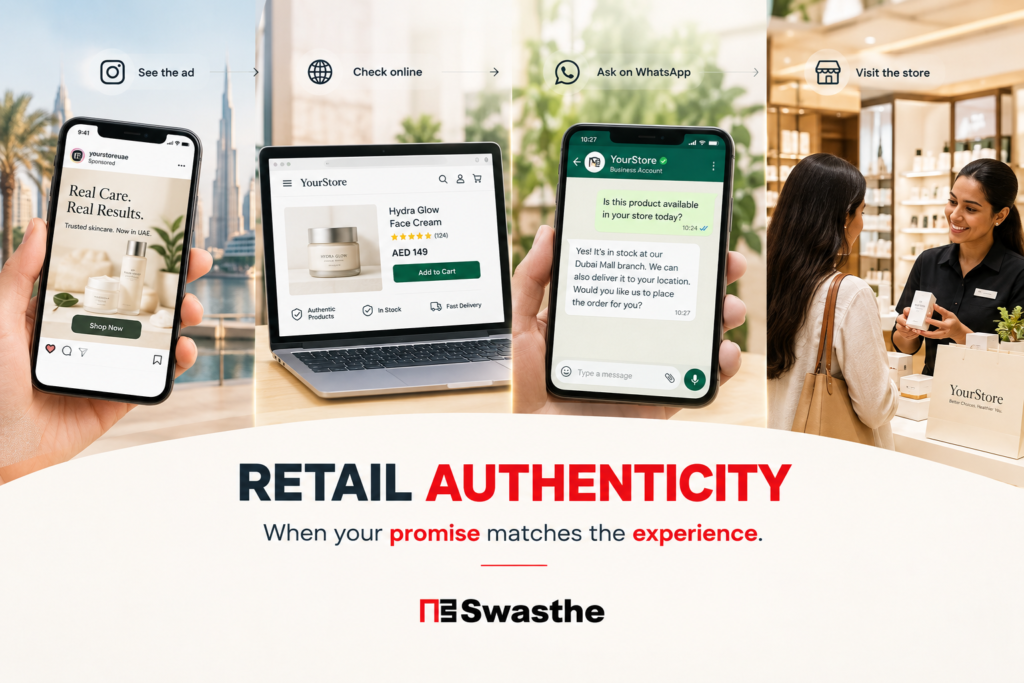
A customer sees your Instagram ad, checks your website, finds the product on WhatsApp, asks if it is available, and then visits your store.
If the price is different, the product is out of stock, the WhatsApp response is slow, or the staff doesn’t know about the promotion, the problem isn’t your advertising. It’s the gap between what your business promises and what it delivers.
The internet has never been louder. Every day, customers scroll through product videos, influencer promotions, sponsored posts, AI-generated images, automated reviews, and brand messages that all compete for attention. Yet as content becomes easier to create, one thing is becoming harder to find: authenticity.
For retailers, this shift matters. Trust is no longer built only through a good-looking website or a discount campaign. Customers now ask deeper questions before they buy. Is this product real? Is this review reliable? Does this store deliver what it promises? Is this brand listening, or just posting? In a market like the UAE, where ecommerce, social commerce, and WhatsApp selling continue to grow, authenticity is becoming a real business advantage.
This blog explores why authenticity is becoming scarce online, how it affects customer behavior, and what UAE retailers can do to build stronger trust across ecommerce, advertising, customer service, and store operations.
Why Retail Authenticity Feels Scarce Online
Digital content has become easy to produce at scale. Businesses can publish posts, launch ads, send messages, and update websites faster than ever. That speed has benefits, but it also creates a problem. Customers see more content, but they trust less of it.
Many online spaces now feel crowded with polished claims and similar-looking promotions. Product descriptions may sound impressive but lack detail. Reviews may appear positive but feel generic. Social media feeds may show perfect results that do not match real customer experiences. When everything looks optimized, customers start looking for signals that feel human, specific, and verifiable.
This is why authenticity has become scarce. It is not because brands have stopped communicating. It is because customers have become better at detecting communication that feels empty. They want evidence, consistency, and real value. They want to know that the business behind the screen is credible.
The New Trust Signals Customers Look For
Authenticity online is not limited to tone of voice. It appears across the full customer journey. A shopper may discover a pharmacy through a search result, compare prices on an ecommerce site, ask a question on WhatsApp, check delivery details, and then visit the store later. Every step either builds trust or weakens it.
Today’s customers often look for trust signals such as accurate product information, clear pricing, real stock availability, fast responses, transparent delivery expectations, helpful after-sales support, and consistent branding across channels. These details may seem basic, but they make a major difference.
For example, if an online store promotes a product that is out of stock, the customer may lose confidence. If a WhatsApp message offers a discount that the POS system does not recognize in-store, the experience feels disconnected. If an ad promises quick delivery but the order tracking is unclear, the customer may not return. Authenticity is built through alignment between message, system, and service.
- Accurate catalogues help customers make confident purchase decisions.
- Consistent pricing reduces confusion between online and in-store channels.
- Responsive WhatsApp support makes the brand feel accessible and human.
- Reliable inventory data prevents disappointment and abandoned orders.
- Clear reporting helps retailers understand what customers actually want.
What This Means for UAE Retailers
The UAE retail market is highly competitive and digitally active. Customers are comfortable comparing options quickly. A beauty store, supermarket, pharmacy, wellness brand, pet care shop, or specialty retailer may not be competing only with nearby stores. It may also be competing with marketplaces, social sellers, delivery apps, and direct-to-consumer brands.
In this environment, authenticity can help smaller and mid-sized retailers stand out. Many customers prefer businesses that feel reliable, responsive, and local. They value clear communication and practical service. Retailers do not need to sound like global brands to earn trust. They need to be clear, consistent, and useful.
This is especially important for categories where trust is central to the purchase. Pharmacy customers need accurate product details and confidence in availability. Beauty shoppers look for genuine product information and relevant recommendations. Wellness customers often compare ingredients and benefits. Pet care customers want dependable guidance for products they buy regularly. In each case, authenticity supports conversion and retention.
The opportunity is simple: retailers that connect their marketing promises with their operational reality can create a better customer experience. That means the ecommerce site, POS, inventory, customer communication, and reporting should not work in isolation. When systems are disconnected, even good marketing can create friction. When systems are connected, trust becomes easier to maintain.
How Retailers Can Build Authenticity in Digital Channels
Authenticity should be managed like a business process, not treated only as a brand personality. It requires practical steps across content, operations, and customer communication.
1. Make Product Information Specific and Useful
Generic product pages do not build confidence. Retailers should add clear product names, correct categories, pricing, availability, usage details where relevant, and high-quality images. For ecommerce SEO, useful product information also helps search engines understand the page and match it to customer intent.
2. Keep Inventory and Promotions Aligned
Few things damage trust faster than promoting products customers cannot actually buy. Retailers should keep stock status, offers, and pricing aligned across online and in-store channels. This reduces cancellations, customer complaints, and manual follow-ups.
3. Use WhatsApp as a Service Channel, Not Only a Sales Channel
WhatsApp marketing can support abandoned cart recovery, repeat purchases, and customer updates. But the channel works best when it feels helpful. Customers should receive relevant messages, clear answers, and timely support. Overuse can weaken trust, while useful communication can strengthen it.
4. Show Real Customer Value in Advertising
Ads should focus on specific customer benefits, not exaggerated promises. A strong campaign can highlight convenience, product range, availability, local service, or seasonal relevance. The best retail advertising connects directly to what the store can deliver.
5. Use Data to Improve the Experience
Authenticity also depends on listening. Retailers can use dashboards and reports to understand sales trends, repeat purchases, slow-moving products, and customer behavior. When decisions are based on real data, communication becomes more relevant and operations become more reliable.
Analysis: Authenticity Is Now an Operational Advantage
The biggest mistake retailers can make is treating authenticity as a content trend. It is much bigger than that. Authenticity is becoming an operational advantage because customers judge brands through outcomes. Did the item arrive? Was the price correct? Did the staff answer quickly? Was the product available? Was the offer easy to redeem?
This changes how retailers should think about digital growth. A business cannot rely only on more ads if the post-click experience is weak. More traffic will not solve poor catalogue management. More messages will not fix unclear stock information. More promotions will not build loyalty if the customer journey feels inconsistent.
Retailers need a connected approach. Ecommerce, POS, inventory, customer management, marketing, and reporting should support one customer experience. This is where integrated systems become valuable. They help reduce gaps between what a brand says and what it can deliver.
Swasthe helps UAE retailers grow online sales while streamlining store operations through ecommerce services, advertising, WhatsApp marketing, and integration with ElintOm retail software. As a Sharjah-based retail growth partner, Swasthe serves pharmacies, wellness brands, beauty stores, supermarkets, pet care businesses, and specialty retailers across the UAE. The company combines digital marketing services with ElintOm retail software to unify ecommerce, POS, inventory, customer management, and operational reporting into one connected ecosystem.
For retailers trying to compete in a trust-sensitive market, this type of connected approach can make authenticity easier to maintain. It supports better customer communication, cleaner operational data, and more consistent digital experiences.
Trust Will Decide the Next Stage of Digital Retail
As online content becomes easier to create, authenticity becomes more valuable. Customers will continue to reward retailers that are clear, reliable, responsive, and consistent. They will also move away from brands that overpromise, confuse, or fail to deliver a smooth experience.
For UAE retailers, the path forward is practical. Keep product information accurate. Align promotions with inventory. Use WhatsApp with purpose. Make ads specific. Connect ecommerce with store operations. Review data regularly. Most importantly, make sure the customer experience matches the message.
Authenticity is not about sounding perfect. It is about being dependable in every customer interaction. In a crowded digital market, that dependability may become one of the strongest growth drivers a retailer can build.
The biggest opportunity for UAE Retailers
Bring Retail authenticity with Swasthe’s Audit → Build → Connect → Grow framework.
Audit: identify where the customer experience breaks.
Build: fix the ecommerce, content, campaigns and customer journeys.
Connect: connect ecommerce, POS, inventory, customer communication and reporting.
Grow: use the resulting data to improve marketing, conversion and retention.
In retail, authenticity is created when what you advertise, what your systems show, and what your customer actually experiences are all the same