



















































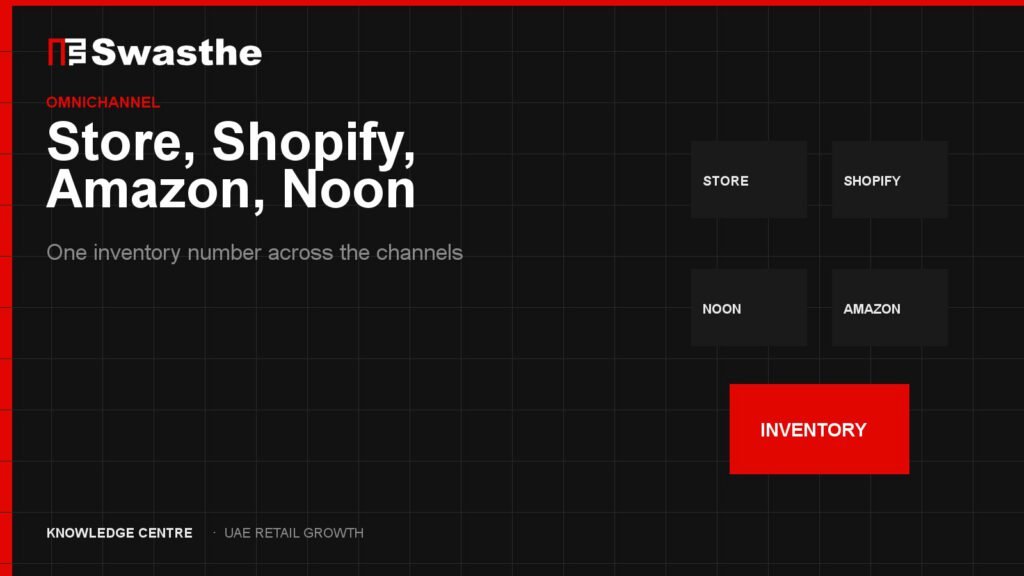
Omnichannel retail in the UAE means a customer can buy in the store, on Shopify, on Amazon.ae or on Noon and meet the same price, the same available stock and a fulfilment promise the pack bench can keep. More channels are not the goal. One operational number behind those channels is the goal.
A brand that looks present everywhere and cancels on Monday is not omnichannel. It is four shopfronts sharing a logo. The repair is connection: inventory, orders and the customer, then demand.
What it looks like on a UAE shop floor
Walk a Saturday. A customer in Dubai Mall sees a serum with three units on the shelf. Their phone shows the same SKU on your Shopify store as in stock for delivery to Sharjah. Amazon.ae shows it available with a marketplace delivery promise. Noon shows a slightly different price because the last file was uploaded before a promotion. The cashier sells the display. The site takes an order at 9pm. Nobody reserved the unit. The packer in Al Quoz finds two, not three.
That morning is the whole topic. Omnichannel retail software, strategy and “unified commerce” language all collapse to a few physical facts: where the unit is, who is allowed to sell it, and who tells the customer the truth before they pay.
What each channel owns
The store owns the queue, the advice, the VAT receipt and the immediate handover. It is often the fastest source of truth for what is actually on a shelf, and the slowest to type that truth into a website.
Shopify owns the brand site and the online checkout. It can hold stock by location when you use it that way. It does not know a mall till sold the last unit unless that till writes back. The practical connection is Shopify, POS and inventory.
Amazon.ae owns a marketplace shopfront with its own fees, ads and delivery promise. A listing can keep selling after your shelf is empty if the quantity feed is late. Seller advertising only makes that faster — see Amazon UAE advertising and margin after the count is true.
Noon owns another UAE marketplace audience. Price, content and stock there are your responsibility to keep aligned. Treat Noon as a channel to reconcile. Do not assume a named connector exists because you use another platform.
WhatsApp owns the conversation, including orders staff close in chat. Those orders are channel volume. If they never reserve stock, they are an invisible fifth shopfront.
None of these should be retired because another exists. Each fits a way of buying. Each fails as a warehouse when it keeps a private quantity.
The inventory number they have to share
Available-to-sell is the contract between channels.
- A unit on a Dubai shelf can be sold in that store, and as pickup from that store, if the page names the branch and the hours.
- A unit in a Sharjah warehouse can be sold for delivery where the courier cut-off is honest. It is not a two-hour Marina pickup.
- A unit already paid for on Shopify is not available on Noon, even if the carton is still on the shelf.
- A unit on a transfer van is not available in either branch.
Publish that number to every channel the same day. A weekly upload is a memory of last Thursday. The symptom list, if you suspect this is already costing refunds, is 15 signs stock is losing money.
Orders have to land in one queue
Stock is half of omnichannel. The other half is the order. A Shopify order, an Amazon order, a Noon order and a WhatsApp order need a place the pack bench watches. If each channel has its own login, Saturday peak becomes four tabs and a missed cut-off.
The sequence after payment — reserve, choose the location, pick, pack, courier, WhatsApp — is online order to last-mile delivery. Payment status has to arrive with the order. A captured card that still looks unpaid will sit while the rider’s window closes. Gateway behaviour is in online payment gateways UAE.
ElintOm is one retail operations platform for this layer: multi-store POS, inventory, a central order and warehouse view, CRM, and — on its current public description — Shopify, Amazon, the website and in-store sales in one queue. Use it when the leak is that operations layer. Keep Shopify, Amazon.ae and Noon as the channels customers already buy from. ElintOm does not replace those shopfronts. Noon is not named on ElintOm’s public pages, so reconcile Noon stock explicitly rather than assuming the feed.
A Saturday that looks like four businesses
A wellness brand with a counter in Dubai Mall and a rack in Sharjah ran Shopify, Amazon.ae and Noon from the same catalogue photos. On paper it was omnichannel. On a Saturday in October the mall sold 6 units of a collagen jar. Shopify, still showing the Thursday upload, took 4 more for “next-day Sharjah.” Amazon.ae took 2 because the feed had not moved. The rack in Sharjah held 7. The mall shelf held 1 display unit staff would not sell. The packer could fill the Sharjah deliveries and nothing else. Three customers got a WhatsApp apology. The Amazon account took a cancellation hit. The ads on the hero SKU kept spending until Monday because nobody had a single available number to pause against.
The fix was not a fourth channel and not a new photoshoot. They named Sharjah as the only ship-from location, stopped the mall counter from publishing a delivery promise, and made a till sale reduce Shopify before the next card payment. Noon was updated the same afternoon from that count, by file, because a live Noon connector was not something they could assume. The following Saturday the same jar sold out once, in one place, and the other channels showed it. That is the omnichannel result worth keeping: fewer apologies, one stockout, no double sale.
What to do before you open another channel
Audit, Build, Connect, Grow still applies. Another marketplace is a Grow move. It belongs after Connect.
- List every place a customer can pay for the same SKU, including WhatsApp.
- For five SKUs, write the quantity each place shows today.
- Make one record the authority. Update the others from it.
- Put every paid order where the packer looks, with location and paid status.
- Then, if demand is the remaining leak, scale the channel that already converts. Marketplace work lives on marketplace growth.
If the quantities already conflict, start a Free Growth Audit so stock, checkout and demand are separated instead of treated as one “sales are down” brief. The stack those systems belong to is the UAE retail technology stack.
FAQ: omnichannel retail UAE
What is omnichannel retail?
Selling in more than one place — store, website, marketplace — from connected stock, orders and customer records, so the promise the customer sees can be fulfilled.
Is selling on Noon and Shopify enough to be omnichannel?
Those are two channels. They are omnichannel when a sale on one reduces what the other can sell, and both orders reach the same pack bench.
Should every branch fulfil online orders?
Only the branches that can pick, pack and meet the cut-off you printed on the site. A mall counter in peak hours is often a poor ship-from location even when it has the unit.
Where does the customer record sit?
With the purchase. A store receipt, a Shopify order and a marketplace order should be recognisable as the same person when you have a phone number or email. Otherwise loyalty and WhatsApp follow-up guess.
What should I read next?
If the break is after payment, read the last-mile article. If the break is the quantity on Shopify versus the till, read the Shopify and POS article. If you want the leak named, start a Free Growth Audit.