


















































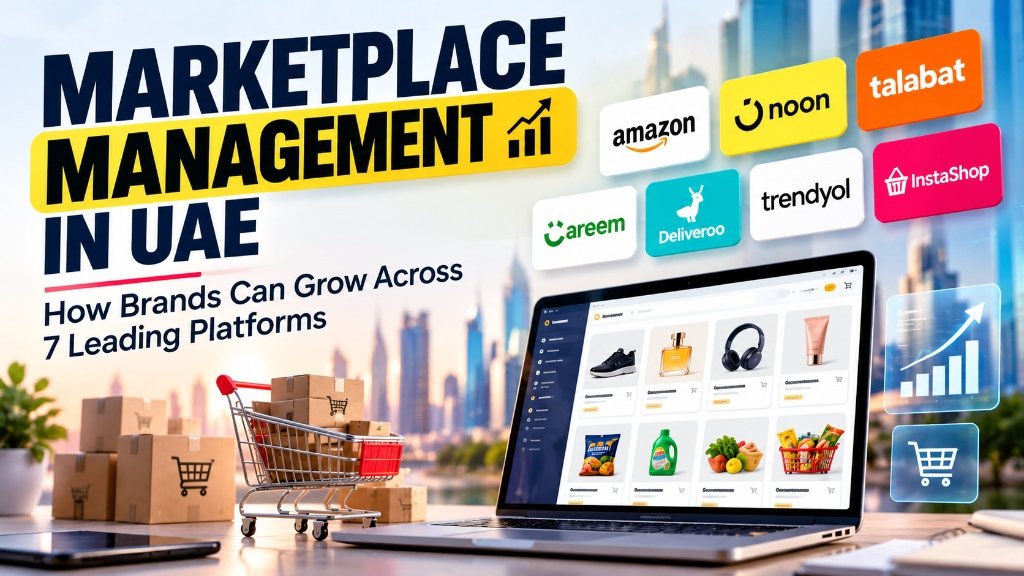
Direct answer: Marketplace management in the UAE is an integrated operating system across catalogue accuracy, real-time inventory allocation, listing discoverability, and unit economics across Amazon, Noon, Talabat, Careem, Deliveroo, Trendyol, and InstaShop. Managing these platforms independently causes stockouts, overselling, and margin erosion; scaling profitably requires connecting warehouse and till truth to every channel.
Selling on marketplaces is no longer simply about making products available online. For brands, manufacturers, distributors, and retailers in the UAE, marketplaces have become critical sales channels. Customers discover products, compare prices, check availability, and make purchasing decisions across platforms such as Amazon, Noon, Talabat, Careem, Deliveroo, Trendyol, and InstaShop.
Each platform offers a different commercial opportunity. But managing them independently creates severe operational friction. Your catalogue may be accurate on Amazon but incomplete on Noon. A product available in your warehouse may appear out of stock on a quick-commerce platform. Promotional campaigns may generate sales volume without delivering adequate margins. Different teams often manage listings, inventory, and advertising without a shared view of performance.
The result is a fragmented marketplace operation that becomes harder to manage as order volumes grow. Successful marketplace management requires more than product listings and advertising. It requires a connected approach to catalogue governance, inventory availability, content optimisation, and profitable growth. Swasthe’s Marketplace Growth model and Audit, Build, Connect, Grow framework help UAE businesses build that discipline.
1. Understanding the UAE Marketplace Landscape
Not all marketplaces operate in the same way. Amazon and Noon are broad e-commerce marketplaces where customers search, compare, and purchase products across diverse categories. Platforms such as Talabat, Careem, Deliveroo, and InstaShop have dominant roles in grocery, convenience, pharmacy, and local retail delivery. Trendyol provides a high-growth channel for product discovery and purchasing across fashion, beauty, home, and lifestyle.
For businesses, these structural differences dictate everything from product assortment to fulfilment workflows and promotional strategy.
Seven Marketplaces, Different Commercial Opportunities
| Platform | Commercial Opportunity | Key Management Priorities |
|---|---|---|
| Amazon UAE | Broad product discovery, prime delivery, high-intent online purchasing | Catalogue quality, inventory forecasting, Buy Box pricing, FBA inbound, Sponsored Ads, and account health (Amazon account management). |
| Noon | General merchandise, strong regional brand presence, high-volume retail promotions | Product listings, FBN vs FBP inventory, Yellow Friday event planning, competitive pricing, and Seller Lab hygiene (becoming a Noon seller). |
| Talabat | Grocery, convenience, pharmacy, and on-demand retail within 15–30 minutes | Assortment planning, real-time stock availability, dark-store replenishment, and in-app banner visibility. |
| Careem | Supermarkets, grocery, pharmacies, and local commerce on the ‘Everything App’ | Product availability, store-level inventory feeds, retailer commercial relationships, and category prominence. |
| Deliveroo | Grocery, convenience, specialty gifting, and neighbourhood retail delivery | Catalogue accuracy, store opening hours, menu/catalogue availability, order fulfilment speed, and targeted promotions. |
| Trendyol | Fashion, beauty, home textiles, and lifestyle categories with international reach | Visual merchandising, size/colour variations, regional pricing, seasonal campaigns, and cross-border logistics. |
| InstaShop | Hyperlocal supermarkets, pharmacies, pet supplies, and neighbourhood retail | Retail partner catalogue mapping, local stock sync, POS integration, and neighbourhood visibility. |
These platforms should never be treated as interchangeable sales channels. On Amazon or Noon, a brand may operate its own direct seller account, managing its own inventory, pricing, and fulfilment arrangements. On grocery and quick-commerce channels, a manufacturer’s products frequently reach consumers through retail partners, supermarket distribution agreements, or platform-operated dark stores.
That distinction is vital. A brand selling through a supermarket chain listed on InstaShop or Talabat may not directly control every product listing or stock update. Its marketplace strategy must account for the retailer’s operational POS systems, distribution frequencies, and commercial terms. The objective is not to be present on every platform; it is to identify where your products can capture sustainable, profitable demand and ensure those channels are run with operational precision.
2. The Four Foundations of Successful Marketplace Management
Although platforms differ, four operational foundations determine how effectively a business converts marketplace traffic into net contribution.
A. Catalogue Management: Build a Reliable Product Foundation
Your product catalogue is the foundation of marketplace operations. A catalogue contains far more than product titles and pack images; it includes the exact data needed to identify, classify, display, price, sell, and replenish products across channels.
For a brand operating across several marketplaces, inconsistent product information quickly creates operational chaos. Consider a personal care manufacturer selling 150 SKUs across five platforms: one platform displays outdated packaging, another shows an old formula, a third lists incorrect pack quantities, and a fourth is missing parent-child variations. These discrepancies confuse shoppers, elevate customer return rates, and invite listing suppression.
- Centralised Product Master: Maintain verified SKUs, barcodes (EAN/UPC), brand registry names, descriptions, technical specs, pack dimensions, and high-resolution approved imagery.
- Platform-Specific Attribute Mapping: Adapt product taxonomies, search terms, and mandatory category attributes to each platform’s specific schema.
- Assortment Planning: Determine which SKUs belong on which platforms based on margin requirements, shipping weight, and consumer buying behaviour.
- New Product Onboarding: Maintain a standard operating procedure for barcode assignment, document approvals (e.g., MOHAP or Dubai Municipality registrations), and portal publishing.
- Data Quality Monitoring: Actively audit inactive listings, suppressed ASINs, incorrect title truncations, and duplicate entries.
B. Inventory and Stock Management: Sell What You Can Deliver
One of the costliest errors in UAE retail is stock unavailability. Businesses often hold inventory across central distribution centres, retail stores, 3PL warehouses, and marketplace fulfilment centres (such as Amazon FBA or Noon FBN). If these locations run on disconnected systems, available stock appears unavailable, or out-of-stock items remain purchasable online.
Imagine a retailer with 1,000 units of a hero SKU. Those units are simultaneously committed to physical stores, wholesale clients, an e-commerce website, and multiple marketplace accounts. If each channel independently displays 1,000 units, the business risks accepting orders it cannot deliver, triggering cancellation penalties, damaged seller ratings, and angry customers.
The operative figure is available-to-sell inventory, calculated after accounting for reservations, allocations, and buffer thresholds:
Available-to-sell stock = Sellable stock on hand − Reserved orders − Channel allocations − Safety stock
Quick commerce introduces local hyper-complexity. A customer ordering on Talabat, Careem, or InstaShop needs delivery within minutes. Availability depends entirely on the dark store or retail branch serving that specific geofence. Central warehouse stock does not solve a stockout in a JLT or Downtown dark store. Manufacturers and distributors must coordinate replenishment schedules with retail partners rather than relying solely on central warehouse dashboards. Connecting this ledger is where platforms like ElintOm and integrated omnichannel inventory systems prevent stock conflicts.
C. Listing Management: Turn Product Availability into Product Discovery
Having products listed on a portal does not mean shoppers will find or buy them. Listing quality directly impacts marketplace algorithm rankings, customer click-through rates, and basket conversion.
- Accurate, Compliant Titles: Include brand name, product line, key functional attribute, pack size, and variant details formatted to platform character limits.
- Conversion-Focused Descriptions & Bullet Points: Answer buyer objections clearly: What is inside the box? How is it used? What certifications or warranties apply?
- High-Resolution Visuals: Provide clean white-background main images, dimension graphics, product infographics, and compliant lifestyle imagery.
- Search & Category Optimisation: Map search backend keywords on Amazon and Noon; optimize category taxonomy and tag associations on quick-commerce apps.
- Dual-Language Localisation: Ensure both English and Arabic content use genuine regional terminology rather than poor machine translations that misstate product specs.
D. Marketplace Growth Management: Increase Profitable Sales
Marketplace success cannot be measured by top-line Gross Merchandise Value (GMV) alone. A brand can scale revenue rapidly while incurring heavy financial losses once marketplace commissions, shipping fees, storage surcharges, advertising spend, and product returns are subtracted.
Every commercial decision must start with unit-level contribution economics:
| Item (Illustrative Sale Value: AED 100 Excl. VAT) | AED Amount |
|---|---|
| Net Product Revenue | AED 100.00 |
| Product & Landed Cost (COGS) | -AED 45.00 |
| Marketplace Commission & Referral Fee | -AED 15.00 |
| Fulfilment & Pick/Pack Cost | -AED 12.00 |
| Marketplace Advertising (PPC / Sponsored Ads) | -AED 10.00 |
| Expected Returns, Damage & Variable Overhead | -AED 4.00 |
| Net Contribution Margin (Before Fixed Overheads) | AED 14.00 (14%) |
If you run a promotional discount of AED 10 without adjusting advertising spend or securing platform fee rebates, your net contribution plummets from AED 14 to AED 4 per unit. You might triple your order count while slashing your gross profit. Disciplined growth management evaluates promotions, PPC campaigns, and assortment based on incremental contribution dirhams, not vanity revenue.
3. Should Your Brand Sell on All Seven Marketplaces?
The answer for most brands is an emphatic no. Channel expansion should be guided by unit economics, operational capability, and customer behaviour—not platform novelty.
| Business Type | High-Fit Marketplace Channels | Strategic Considerations |
|---|---|---|
| Consumer Electronics & Hardware | Amazon UAE, Noon, Trendyol | High search volume, technical comparison, warranty clarity, serial number tracking, and FBA/FBN logistics. |
| Fashion & Lifestyle Apparel | Trendyol, Amazon UAE, Noon | Rich visual merchandising, size variant matrices, seasonal promotions, and high customer return management. |
| FMCG & Packaged Goods | Noon, Amazon UAE, Talabat, Careem, InstaShop, Deliveroo | Multi-packs, retail partner distribution, stock freshness, high reorder frequency, and dark-store replenishment. |
| Multi-Branch Grocery & Supermarkets | Talabat, Careem, Deliveroo, InstaShop | Branch-level catalogue syncing, store-level inventory feeds, 15-minute pick-and-pack SLAs, and local promotions. |
| Beauty, Cosmetics & Personal Care | Amazon UAE, Noon, Trendyol, InstaShop (pharmacies) | Authenticity seals, MOHAP/Dubai Municipality approvals, climate-controlled warehousing, and influencer cross-promotion. |
| Home & Living Brands | Amazon UAE, Noon, Trendyol, selected Quick-Commerce | Volumetric freight costs, bulky item delivery SLAs, and bundle pricing to lift average order value. |
4. Why Multi-Marketplace Management Becomes Difficult as Brands Scale
A business selling on a single platform can manage operations through Seller Central and a couple of spreadsheets. However, once you sell 200+ SKUs across Amazon, Noon, and three quick-commerce apps, manual workflows fail.
- Fragmented Product Information: Marketing updates product imagery on Amazon, but Noon continues displaying outdated packaging, resulting in customer disputes and bad reviews.
- Disconnected Inventory Ledgers: Warehouse staff update inventory once a week. In the meantime, weekend quick-commerce surges sell stock already promised to Amazon FBA, leading to stockouts and platform penalties.
- Uncoordinated Commercial Spending: Marketing runs aggressive Meta ads driving to Amazon while sales teams offer price cuts on Noon. The channels cannibalise each other, destroying price integrity.
- Opaque Financial Reporting: Portal statements calculate storage, shipping, return fees, and commissions differently. Executive leadership cannot determine which channel generates actual bottom-line cash.
5. Building an Effective Multi-Marketplace Operating Model
A resilient multi-marketplace operating model connects people, data, and processes across six clear stages:
- Establish a Single Source of Product Truth: Maintain an authoritative master product database for barcodes, titles, specifications, dual-language copy, and certified imagery.
- Map Inventory Allocation Pools: Separate sellable inventory into warehouse buffers, FBA/FBN consigned stock, and store-level allocations so sudden sales spikes on one channel cannot cause overselling on another.
- Define Channel Ownership & SLAs: Establish explicit ownership for listing creation, inventory updates, daily order processing, and customer dispute handling.
- Deploy a Unified Commercial Scorecard: Review revenue, contribution margins, advertising return on ad spend (ROAS), and in-stock rates across all channels every Monday.
- Run a Structured Operational Rhythm: Conduct daily availability audits, weekly pricing and stock reviews, monthly SKU-level profitability assessments, and quarterly channel strategy reviews.
- Continuously Eliminate Inefficiencies: Delist chronic loss-making SKUs, fix low-converting listings, renegotiate courier or distribution terms, and automate routine data exchanges.
6. The Marketplace KPIs Every UAE Brand Should Track
| Management Area | Core Operational & Commercial KPIs | Commercial Significance |
|---|---|---|
| Catalogue Health | Active listing count, catalogue completeness %, suppressed/inactive listing rate | Ensures products remain eligible for search discovery and Buy Box rotation. |
| Inventory & Stock | In-stock rate (%), stockout frequency, days of inventory cover, inventory turnover | Prevents lost sales and algorithm ranking downgrades caused by stockouts. |
| Listing Conversion | Glance views/sessions, click-through rate (CTR), conversion rate (CVR), return rate by reason code | Identifies whether pricing, imagery, or descriptions fail to convince high-intent shoppers. |
| Growth & Commercials | Gross Merchandise Value (GMV), net sales, average order value (AOV), TACoS (Total Advertising Cost of Sales) | Tracks real market expansion and advertising efficiency across portfolios. |
| Profitability | Net contribution margin per SKU, total platform fee burden, refund/damage cost % | Verifies whether channel revenue translates into net operating profit. |
| Fulfillment & Operations | Order defect rate (ODR), late dispatch rate, pre-fulfilment cancellation rate | Maintains top-tier seller badges (Amazon Prime, Noon Express) and avoids account suspensions. |
7. How Marketplace Management Connects with Retail Growth and Technology
Marketplaces do not operate in a vacuum. For established UAE businesses, digital marketplaces are components of a wider omnichannel ecosystem that includes physical showrooms, wholesale distribution, and direct-to-consumer Shopify storefronts.
When these channels are disconnected, growth creates duplicated manual effort and channel conflict. Integrating marketplace management into a broader retail architecture requires alignment across three areas:
- Retail Growth: Marketplaces should drive net new customer acquisition and category expansion without cannibalising physical store footfall or direct website profitability.
- Retail Transformation: Commercial, merchandising, and warehouse teams must share real-time visibility and aligned incentives rather than competing over channel attribution.
- Retail Technology: Connecting modern ERP/POS systems like ElintOm with marketplace APIs and warehouse management systems ensures stock updates flow automatically and orders route to the nearest fulfilment hub.
8. A Practical Marketplace Growth Assessment for UAE Brands
Before allocating additional budget to marketplace ads or onboarding a sixth platform, run this diagnostic check:
- Catalogue: Are product barcodes, specifications, and imagery uniform across Amazon, Noon, and quick-commerce listings?
- Inventory: Can you view real-time available-to-sell inventory across warehouses and retail branches right now?
- Fulfilment: What is your average pick, pack, and handover time for quick-commerce and marketplace orders?
- Unit Economics: Do you know the exact net contribution margin of your top 20 marketplace SKUs after all platform fees and ad spend?
- Governance: Is one named operator accountable for listing hygiene, stock accuracy, and portal performance across all platforms?
If two or more answers are unclear, expanding to more channels will only amplify your operational leaks. Solve inventory visibility and unit economics before scaling spend.
9. How Swasthe Approaches Marketplace Growth
At Swasthe, we view marketplace management as an operational discipline within your broader business growth strategy. We partner with UAE brand owners, manufacturers, distributors, and multi-branch retailers to transform fragmented marketplace setups into profitable, connected growth engines.
Our approach follows four sequential phases:
- Audit: We diagnose your catalogue integrity, inventory sync, fee structures, advertising spend, and SKU-level contribution margins across channels.
- Build: We establish verified product masters, resolve listing suppressions, optimise dual-language content, and fix margin-leaking promotions.
- Connect: We connect warehouse, POS, and ERP data flows to ensure stock availability updates accurately across Amazon, Noon, and retail partners.
- Grow: We deploy disciplined marketplace advertising, assortment planning, and promotional strategies designed to maximize bottom-line profit.
10. Conclusion: Build a Marketplace Strategy That Creates Business Value
Amazon, Noon, Talabat, Careem, Deliveroo, Trendyol, and InstaShop offer unprecedented opportunities to reach UAE consumers. But adding more channels does not automatically create enterprise value. Sustainable growth requires choosing the right platforms, maintaining clean catalogue data, synchronising inventory in real time, and ruthlessly protecting contribution margins.
If your marketplace operations feel fragmented or you want to verify whether your channels are generating genuine profit, start with a diagnostic review. Explore Swasthe’s Marketplace Growth solutions or request a Free UAE Growth Audit to uncover hidden revenue leaks and build a scalable retail engine.
FAQ: Marketplace Management in UAE
What is marketplace management in the UAE?
Marketplace management in the UAE is the end-to-end operational and commercial management of brand sales across platforms like Amazon.ae, Noon, Talabat, Careem, Deliveroo, Trendyol, and InstaShop. It covers catalogue hygiene, stock synchronization, listing optimization, advertising, order fulfillment, and contribution margin tracking.
How do Amazon UAE and Noon differ in operational priorities?
Amazon UAE prioritizes Buy Box ownership, strict FBA inbound guidelines, Brand Registry tools, and sophisticated keyword-targeted PPC advertising. Noon emphasizes Seller Lab compliance, competitive pricing, FBN vs FBP inventory choices, and participating in massive regional sales events like Yellow Friday.
How do quick-commerce platforms like Talabat, Careem, and Deliveroo work for brands?
On quick-commerce platforms, products are typically delivered in 15 to 45 minutes from dark stores or partnered retail locations. Manufacturers and distributors usually sell inventory to or through retail partners and dark stores rather than shipping directly to consumers from a central warehouse.
What role does InstaShop play in UAE retail?
InstaShop connects local consumers with neighbourhood supermarkets, pharmacies, pet shops, and specialty stores. For brands, presence on InstaShop is largely determined by ensuring partnered retail outlets maintain full shelf availability and accurate POS catalogue mapping.
What categories perform best on Trendyol UAE?
Trendyol is especially strong in fashion apparel, footwear, accessories, home textiles, and beauty/lifestyle products, offering brands exposure to both UAE shoppers and broader regional consumer demand.
Should a UAE brand launch on all seven marketplaces simultaneously?
No. Launching on too many platforms at once strains inventory management and marketing capital. Brands should start on one or two high-fit platforms (e.g., Amazon and Noon for general retail, or Talabat/InstaShop for FMCG and grocery), establish profitable unit economics, and expand sequentially.
How do you calculate available-to-sell inventory across multiple marketplaces?
Available-to-sell inventory equals total sellable stock on hand minus open/unfulfilled orders, safety stock buffers, and stock already consigned to FBA or FBN. A centralized operations ledger prevents overselling by updating available quantities across channels in real time.
Why do marketplace promotions often reduce profitability instead of increasing it?
Promotions often lower the selling price while platform commissions, fulfillment fees, and advertising costs remain constant or rise. Without calculating product-level contribution margins in advance, higher sales volume can result in lower total profit.
How does ElintOm prevent overselling across UAE marketplaces?
ElintOm functions as a central retail ERP and operations ledger that unifies physical store POS tills, warehouse bins, and online marketplace feeds. When an item is sold in-store or on one platform, ElintOm instantly deducts available stock across all connected channels.
Who controls product listings on quick-commerce apps: the brand or the retailer?
On grocery and quick-commerce apps, listing content and in-stock flags are frequently managed by the participating retailer or dark-store operator. Brands must work collaboratively with retail buyers and distributors to provide standardized content, barcodes, and pack images.
What is the difference between FBA / FBN and direct seller fulfillment?
FBA (Fulfillment by Amazon) and FBN (Fulfilled by Noon) require sending inventory to the marketplace’s fulfilment centre, where they handle storage, picking, packing, and customer delivery. Direct seller fulfillment (FBM/FBP) means you store and dispatch products from your own warehouse using approved couriers.
How does UAE VAT apply to marketplace sales?
Marketplace sales to UAE consumers are subject to 5% UAE VAT. Marketplace platforms collect and report fees with VAT invoices, but sellers remain responsible for properly recording output VAT on gross sales and filing accurate returns with the Federal Tax Authority (FTA).
What are the essential KPIs on a weekly marketplace scorecard?
A weekly scorecard should track in-stock percentage, buy-box win rate, total net revenue, blended TACoS (Total Advertising Cost of Sales), return rates by SKU, and net contribution margin after all marketplace deductions.
How can a UAE brand begin auditing its marketplace performance with Swasthe?
You can request a Free UAE Growth Audit or consult our Marketplace Growth team. We evaluate your current channel mix, catalogue accuracy, inventory flows, and contribution margins to identify immediate revenue and margin opportunities.