

















































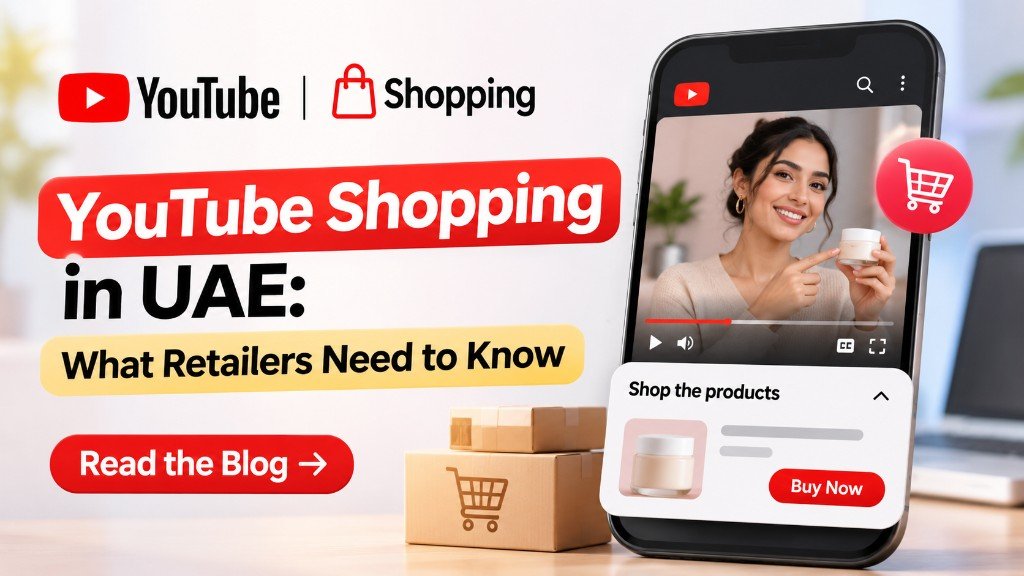
A customer watches a skincare creator demonstrate a new moisturiser. The creator explains how it feels, compares it with another product and shows the results. The customer is interested—but instead of searching Google, opening a marketplace and trying to find the exact product, they can now discover tagged products directly through YouTube Shopping.
That is the shift Google is bringing to the UAE.
On 26 October 2026, Google announced the launch of its YouTube Shopping affiliate programme in the UAE, Saudi Arabia and Egypt, with Amazon as its first affiliate partner in the region. Eligible creators can tag products in videos, Shorts and livestreams, making it easier for viewers to move from product discovery to purchase.
For retailers and brands, this is more than another platform feature. It signals a broader change in how people discover products, evaluate their options and decide what to buy.
The important question for UAE businesses is not simply how to get their products featured in videos. It is how to turn that attention into profitable, sustainable growth.
From watching a video to discovering a product
For years, retailers have treated video primarily as a marketing tool.
A brand publishes a product demonstration, collaborates with a creator or runs a YouTube advertisement. The objective is to build awareness, generate interest and encourage the viewer to visit a website or store.
But every additional step creates an opportunity for the customer to drop off.
The viewer may forget the product name, search for an alternative, encounter several competing listings or abandon the journey altogether.
YouTube Shopping aims to reduce this friction by bringing product discovery closer to the content that creates the interest in the first place.
According to Google’s regional announcement, eligible creators can tag products within their content, while viewers can access product details and purchase options without having to interrupt their viewing to search elsewhere. Google is also introducing AI-assisted product tagging and QR-code shopping for viewers watching on connected TVs.
The significance is straightforward: the content that inspires a purchase can also become a more direct route to completing it.
For shoppers, this can make buying more convenient. For retailers, it creates another opportunity to reach customers when their interest is high.
Read Google’s official announcement.
Why this matters for UAE retailers and brands
The UAE has a diverse retail market, from beauty and wellness brands to electronics sellers, specialty retailers and home businesses. Product discovery does not happen through one channel alone.
Customers may discover something on social media, research it on YouTube, compare prices on Amazon or Noon, visit a physical store and eventually buy through an ecommerce website.
YouTube Shopping makes the connection between content and commerce more direct, particularly for products that benefit from demonstration, explanation or comparison.
Consider a few examples.
Beauty and skincare
A creator demonstrates a skincare routine and explains how different products fit into it. Viewers can discover the featured products while watching.
For a beauty brand, the opportunity goes beyond reaching more people. Useful demonstrations can help customers understand product differences and make more informed purchasing decisions.
But the retailer still needs accurate product information, available stock, competitive pricing and a reliable fulfilment process.
Electronics and consumer products
A detailed review can help shoppers understand the differences between products that appear similar in a catalogue.
A tagged product creates a more direct path from that evaluation to the product listing. However, the quality of the listing, the clarity of the specifications and the customer’s confidence in the seller still matter.
Home, lifestyle and specialty retail
Some products are easier to appreciate when people see them being used.
A video demonstrating a kitchen appliance, home accessory or specialist product can answer questions that a static image cannot. Connecting that demonstration with a purchase option may shorten the journey from interest to action.
In each case, the opportunity comes from matching the right content with the right product and a buying experience that delivers on the promise.
The hidden challenge: attention does not automatically create growth
This is where retailers need to look beyond the announcement.
Imagine a product featured in a popular video. Interest increases, shoppers visit the listing and orders begin to arrive.
That sounds like success. But what happens next?
The product is out of stock just as demand increases.
The marketplace listing contains outdated information or weak product images.
Orders increase, but the business cannot fulfil them quickly enough.
The retailer spends more to support the campaign but does not know whether the additional sales are profitable.
Customers make a first purchase but receive little follow-up encouragement to return.
In each case, the business may generate attention without capturing the full commercial value.
This is a familiar problem in retail. Marketing, ecommerce, inventory, fulfilment and customer management are often handled through separate tools and teams. A campaign can perform well while the wider business struggles to respond.
YouTube Shopping does not automatically solve these issues. It provides another route for product discovery and purchase, but retailers still need the right commercial and operational foundations.
More demand is valuable only when the business can convert it, fulfil it and learn from it.
What UAE retailers should prepare now
Retailers do not need to wait for every detail of a new shopping format to be settled before preparing their businesses. Several practical steps can improve readiness for creator-led commerce and other emerging sales channels.
1. Identify products that work well in video
Start with products that benefit from demonstrations, comparisons, tutorials or real-world use.
Ask what a customer needs to see or understand before deciding to buy. The answer can help determine which products are most suitable for creator partnerships and video-led discovery.
Not every product requires a complicated content strategy. The aim is to make useful product information easier to find and understand.
2. Improve product listings before investing in reach
A video can create interest, but the product listing often has to finish the job.
Review product titles, images, descriptions, specifications, pricing, availability and customer reviews. Make sure the information is accurate and consistent across the channels where the product is sold.
If the listing leaves important questions unanswered, additional traffic may not translate into additional orders.
3. Check inventory and fulfilment readiness
A sudden increase in demand can expose operational weaknesses.
Retailers should understand current stock levels, replenishment times, fulfilment capacity and how orders are managed across their physical stores and online channels.
Where several channels use the same inventory, accurate synchronisation becomes especially important. A product advertised as available should actually be available to sell.
4. Develop content that helps customers make decisions
Creator content should do more than attract views.
Demonstrations, comparisons, product walkthroughs and answers to common customer questions can help shoppers evaluate whether a product meets their needs.
Choose creators based on audience relevance, credibility and content quality—not follower numbers alone. Agree on measurable objectives and make sure commercial relationships and affiliate activity are disclosed appropriately.
5. Measure business outcomes, not just engagement
Views, likes and clicks can indicate interest, but they do not establish whether a campaign is commercially successful.
Where the necessary data is available, retailers should monitor product clicks, attributable orders, conversion rates, average order value, returns, commissions and contribution margin.
The goal is to understand whether the additional sales justify the cost of producing content, paying commissions and fulfilling orders.
Retailers should also verify the current programme requirements before committing to a specific YouTube Shopping strategy. Creator eligibility, participating products and merchant arrangements can differ.
6. Connect the customer journey
A shopper may discover a product on YouTube, buy it through a marketplace and later contact the retailer with a question or make another purchase through a different channel.
Retailers need to understand how those interactions fit into the wider customer journey.
That does not mean every channel must be forced into one system. It means the business should have a practical way to manage product information, orders, customer service and performance without creating unnecessary operational gaps.
The bigger opportunity: connect growth, technology and transformation
YouTube Shopping is one example of a wider retail shift. The boundaries between content, customer acquisition, ecommerce and retail operations are becoming less distinct.
For UAE businesses, responding effectively requires more than adding another marketing channel.
It requires three connected capabilities.
Retail Growth: turn discovery into revenue
Businesses need a clear approach to attracting the right audience, presenting products effectively and improving conversion.
Creator content and video-led shopping can complement existing ecommerce, marketplace and retail growth activities. They should form part of a commercial strategy rather than operate as isolated campaigns.
Retail Technology: manage the business behind the sale
As sales channels multiply, retailers need reliable product information, inventory visibility, order management and performance reporting.
The right technology helps the business maintain control as demand moves across channels.
ElintOm is one retail operations platform in that ecosystem: product records, stock, orders and branches, connected to ecommerce and marketplaces. The wider choice of what sits where is covered in the UAE retail technology stack.
Retail Transformation: make the channels work together
The next challenge is connecting the physical store, ecommerce, marketplaces, customer communication and operational workflows.
When these parts work together, businesses are better placed to respond to demand, manage customer experiences and understand what is happening across their operations.
This is the distinction between simply participating in a new shopping trend and building a business that can benefit from it consistently.
The retailers who benefit most will be the ones prepared to deliver
YouTube Shopping creates an interesting new opportunity for product discovery and creator-led commerce in the UAE. It may be particularly relevant to brands whose products benefit from demonstration, trusted recommendations and visual storytelling.
But a new shopping feature is not, by itself, a growth strategy.
Retailers still need the right products, compelling listings, reliable inventory, effective fulfilment and a way to measure commercial outcomes. They also need to understand how each new channel fits into the wider business.
The opportunity is to build a retail operation in which marketing creates demand, technology supports the transaction and connected systems help the business deliver.
At Swasthe, we help UAE retailers and service businesses identify growth barriers, improve their commercial performance and connect the systems behind their operations.
Wondering whether your business is ready for the next shift in retail?
Apply for a UAE Growth Audit to identify the gaps between demand, conversion, customer follow-up and operations—and determine what to prioritise next.
Sources
- Google: Watch It, Love It, Buy It — YouTube Shopping Arrives in the Middle East
- YouTube Help: Tag Amazon Products with YouTube Shopping
Frequently Asked Questions
What is YouTube Shopping in the UAE?
YouTube Shopping is the affiliate programme Google launched in the UAE, Saudi Arabia and Egypt on 26 October 2026. Eligible creators can tag products in videos, Shorts and livestreams so a viewer can move from a product in the content toward a purchase. Google’s announcement is the source for the launch.
How does YouTube Shopping work with Amazon in the UAE?
Amazon is the first affiliate partner in the region. Eligible creators tag Amazon products, and viewers can open product details and purchase options without leaving the viewing flow to search. Google is also introducing AI-assisted product tagging and QR-code shopping for connected TVs. Check YouTube’s current tagging requirements before you plan around a specific product or creator, because eligibility and merchant arrangements can differ.
What should UAE retailers prepare before YouTube Shopping?
Start with products that benefit from a demonstration. Then check the listing, stock, fulfilment capacity and whether orders from more than one channel stay in sync. A tagged video cannot repair an out-of-date listing or a product that is not actually available to sell.
Does YouTube Shopping replace a retailer’s ecommerce site or marketplace?
No. A shopper may discover a product on YouTube, buy it on a marketplace and later purchase again through another channel. YouTube Shopping is another route from content to purchase. Marketplace listings, the store and the ecommerce site still have to agree on the product, the price and the stock.
How should a retailer measure YouTube Shopping?
Views, likes and clicks show interest. Where the data exists, also track product clicks, attributable orders, conversion rate, average order value, returns, commissions and contribution margin. The useful question is whether the extra sales cover the content, the commission and the cost of fulfilling the order.
YouTube Shopping can create demand. The commercial question is whether the listing, the stock and the fulfilment can take it.
Read next: Marketplace management in the UAE · Omnichannel retail in the UAE · Retail technology stack UAE · Marketplace Growth · Where growth leaks