



















































When Apple introduced the iPod in 2001, it wasn’t the first company to make a portable digital music player. When it introduced the iPhone in 2007, it wasn’t the first company to make a smartphone.
Yet Apple changed what customers expected from both categories.
The iPod made digital music feel simple and accessible. The iPhone brought together communication, music and internet access in an experience that redefined what a phone could be.
Apple’s advantage wasn’t simply that it had new technology. It was that the company made technology desirable, understandable and convenient for customers.
Now, with the iPhone Duo, Apple faces a different challenge.
Its foldable phone enters a category that other manufacturers have already explored. The larger screen, multitasking capabilities and compact folded design offer new possibilities. But will customers see those possibilities as reasons to upgrade, or will they admire the technology without feeling the need to own it?
For retailers and business leaders, this is more than a smartphone story. It is a question about how innovation becomes demand — and how demand becomes profitable growth.
1. Apple has succeeded before by changing the customer experience
Consider Apple’s earlier product launches.
The iPod: making digital music easier
When Apple launched the iPod, portable digital music players already existed. Apple differentiated its offering through a combination of design, ease of use and integration with its music software.
The message, famously expressed as “1,000 songs in your pocket,” translated a technical product into an immediate customer benefit.
The customer didn’t need to understand the engineering. They understood the freedom of carrying a large music collection in a small device.
The iPhone: changing what a phone could be
In 2007, the iPhone combined a phone, an iPod and internet communication in a touchscreen-led experience. Smartphones were already available, but Apple’s approach changed how many consumers interacted with their devices.
The opportunity wasn’t just to sell another phone. It was to make a different kind of smartphone experience desirable.
Both examples illustrate an important principle: successful innovation often comes from changing the meaning of a product for the customer, not merely improving its specifications.
However, history doesn’t guarantee that every new Apple product will repeat those successes. The iPhone Duo must establish its own reason to exist.
2. The iPhone Duo: a phone, a productivity device or a premium statement?
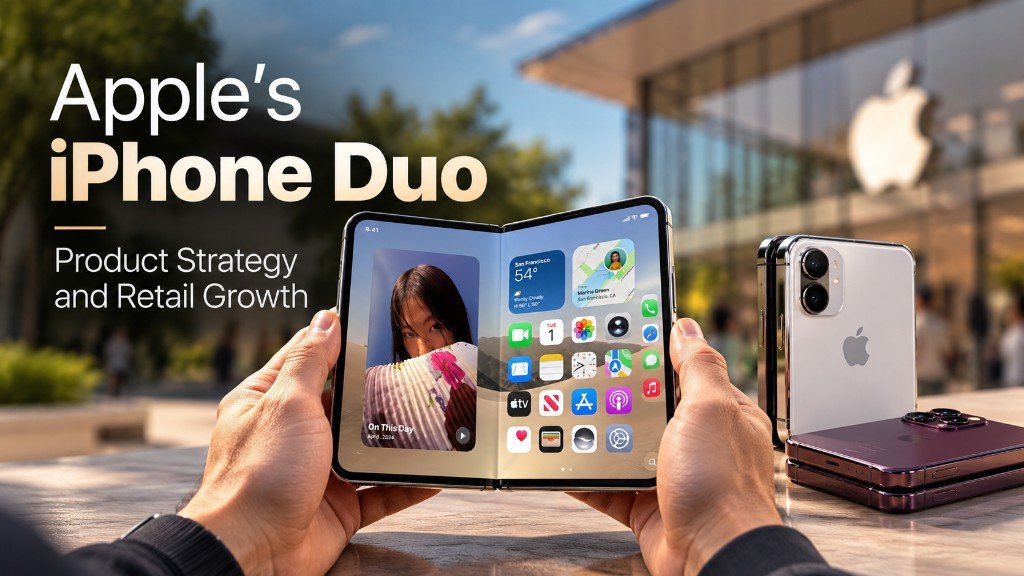
Apple’s iPhone Duo brings a folding display to the iPhone range, with a larger inner screen designed for multitasking, entertainment and productivity.
The proposition is straightforward. Users can open the device to work across applications, view content on a larger screen and handle activities that may be less comfortable on a conventional smartphone.
For some customers, this could be genuinely useful.
A professional travelling between meetings might appreciate viewing documents while attending a video call. Someone who frequently switches between messaging, email and work applications could benefit from a larger workspace. A customer who watches content on the move might value the expanded display.
But consider another customer who mainly uses a phone for calls, WhatsApp, banking, photographs and social media.
Their existing device may already do everything they need.
Both customers can recognise the Duo’s technological achievement. Only one may have a compelling reason to pay a premium for it.
That is the product’s central commercial challenge.
Apple must demonstrate not only what the device can do, but why those capabilities matter in the customer’s everyday life.
3. The business model behind the launch
The iPhone Duo doesn’t have to appeal to every smartphone buyer to make strategic sense.
At a reported US starting price of $1,999, it occupies a premium position. That creates both an opportunity and a constraint: the potential revenue per sale is substantial, but the number of customers willing to pay that price may be limited.
Apple could pursue several commercial objectives simultaneously.
- Increase revenue per customer. A premium product gives existing customers another upgrade option and may increase average selling prices.
- Create a reason to upgrade. A visibly different design offers a stronger reason to consider replacing an older device than a routine specification improvement.
- Strengthen customer loyalty. If the experience works particularly well with Apple’s software and services, the product could reinforce the wider ecosystem.
- Establish a new premium category. Even if the first generation appeals mainly to enthusiasts and professionals, it could help Apple learn which use cases matter and how the category might develop.
These are plausible strategic objectives, not confirmation of Apple’s internal decision-making.
The important point is that a product launch should be evaluated against its intended business objective. A niche product can be successful if it delivers profitable revenue, strengthens the brand or creates a foundation for future growth.
The mistake would be to assume that every new product must immediately achieve mass-market adoption.
4. The real battle may be in the messaging
A new technology can be impressive and still be difficult to sell.
Imagine two ways of introducing the iPhone Duo.
The first message highlights the folding display, cameras, processing power and multiple application windows.
The second shows a professional travelling between meetings, reviewing a document while joining a call, and leaving the tablet behind because the phone meets both needs.
The first communicates the technology. The second communicates a reason to buy it.
Neither approach makes the technology irrelevant. Rather, the technology becomes more persuasive when customers understand what it enables them to do.
This is where Apple’s launch messaging matters.
The company needs to make a new form factor feel intuitive rather than unfamiliar, useful rather than complicated, and desirable rather than merely expensive.
Its passport-sized positioning when folded also addresses a practical concern: how can a device offer a larger screen without becoming inconvenient to carry?
That is a stronger proposition than simply saying that the phone has a folding screen.
The marketing challenge is to connect an unfamiliar product with a familiar human need.
But messaging cannot carry the entire burden. If customers discover that multitasking is awkward, battery life is inadequate for their routines, or the device is less comfortable than expected, the actual experience will eventually overpower the promise.
The launch must deliver on what the marketing leads customers to expect.
5. When customers are more selective, desire must justify the price
Premium products can continue to attract customers even when budgets are under pressure. But higher prices can make the purchase decision more deliberate.
Customers may ask whether the new device improves their lives enough to justify the expense, whether their current phone still works perfectly well, and whether they would be better off spending the money elsewhere.
This creates an interesting tension for Apple.
Its brand can generate aspiration, trust and anticipation. Its retail experience can help customers explore the product. Its ecosystem can make the upgrade more attractive.
Yet the final decision still depends on perceived value.
A customer may want a product because it is new. They may buy it because they admire the brand. But long-term satisfaction depends on whether it becomes useful enough to earn a place in their everyday routine.
This distinction matters for every premium retailer.
A beauty brand can launch a technologically advanced skincare device. A fashion business can introduce a premium collection. An electronics retailer can stock a new category of connected products.
In each case, the product’s novelty may attract initial attention. Its value proposition determines whether customers consider the price worthwhile.
6. What retailers should learn from Apple’s strategy
The iPhone Duo raises five questions that retailers should consider before launching a product or investing in new technology.
Who genuinely needs it?
A product designed for everybody often has a less convincing message than one designed around a clearly understood customer problem.
Identify the customers most likely to benefit, how often they experience the problem and what they currently use as an alternative.
Is the benefit easy to understand?
Customers should quickly understand what improves in their lives.
If a product requires a lengthy explanation, retailers may need better demonstrations, clearer product pages or more effective sales conversations.
Does the price make sense to the customer?
The business must understand the relationship between perceived value, alternatives and willingness to pay.
A premium price can support stronger margins, but only if enough customers recognise the benefit.
Does the experience deliver on the promise?
The product, website, advertising, sales team and after-sales support should communicate a consistent proposition.
A compelling campaign may generate the sale. Product quality, convenience and service influence what happens afterwards.
Is the launch creating profitable growth?
Retailers should look beyond impressions, launch-day sales and initial excitement.
They need to understand margins, customer acquisition costs, returns, stock availability, repeat purchases and whether the new product creates additional revenue rather than simply shifting sales from an existing product.
These measures help distinguish commercial growth from temporary attention.
7. The wider lesson: technology must work with the business
There is another dimension to this story.
Even a desirable product can underperform if the business cannot deliver it effectively.
Marketing may create demand, but insufficient stock can lead to lost sales. Poor product information can reduce conversion. Fragmented reporting can make it difficult to understand which campaigns produce profitable customers. Weak customer follow-up can waste opportunities for repeat purchases.
This is particularly relevant to retailers operating across physical stores, ecommerce websites and marketplaces.
Product strategy, marketing, inventory, customer data and operations cannot be treated as isolated activities. They need to work together.
At Swasthe, this is how we approach retail growth: understand the customer and the commercial problem first, identify where growth is being lost, and then connect the right strategy, technology and execution.
The objective isn’t to add more tools or launch more campaigns simply because they are available.
It is to make the business better at attracting the right customers, converting demand and generating profitable revenue.
Conclusion: will Apple create a new need or fulfil an existing one differently?
The iPhone Duo could become an important product if Apple makes the folding experience genuinely useful, communicates its benefits clearly and delivers an experience that customers value over time.
Its success won’t be determined by the folding screen alone. It will depend on the relationship between technology, customer behaviour, brand perception, pricing and everyday usefulness.
Apple’s earlier successes offer a lesson, not a guarantee. Being different attracts attention. Making that difference meaningful creates a stronger reason to buy.
Every retailer faces the same choice when introducing a product, adopting a technology or investing in growth.
Are we solving a problem customers genuinely want solved, or are we relying on novelty to create demand?
The strongest businesses understand both how to create desire and how to deliver lasting value.
Because launching something new creates an opportunity. Turning that opportunity into profitable, sustainable growth is the real achievement.
Frequently Asked Questions
1. What is the main lesson retailers can learn from Apple’s iPhone Duo?
The main lesson is that innovation creates value when it solves a real customer problem. Retailers should communicate clear benefits, justify the price, deliver a consistent customer experience, and measure profitable growth.
2. Why is understanding customer needs important before launching a product?
Understanding customer needs helps businesses identify who is most likely to buy, what problem the product solves, and which alternatives customers currently use. This makes product positioning and marketing more relevant.
3. How can retailers market a premium product effectively?
Retailers should explain the practical benefits of the product, demonstrate how it improves the customer’s experience, and establish why its price is justified. Strong messaging should be supported by product quality and customer service.
4. How should businesses measure the success of a product launch?
Businesses should evaluate revenue, profit margins, customer acquisition costs, returns, stock availability, repeat purchases, and incremental sales. Impressions and launch-day sales alone do not establish long-term success.
5. Why must marketing and retail operations work together?
Marketing creates demand, but stock shortages, poor product information, fragmented reporting, and weak customer follow-up can prevent that demand from becoming revenue. Coordinated operations help businesses convert opportunities into profitable sales.
6. How can Swasthe help retailers improve business growth?
Swasthe positions itself as a retail growth partner that helps businesses understand customer demand, identify revenue leaks, and connect marketing, sales, technology, and operations. Businesses can explore its Free Growth Audit to assess potential improvement opportunities.
Swasthe is a retail growth partner helping businesses connect customer demand, sales, technology and operations to build more sustainable growth.
Read next: Retail Growth Strategy UAE: Audit, Build, Connect, Grow · Why UAE Retailers Lose Sales Even When Their Ads Are Working · UAE Retail Growth Audit: 25 Things to Check Before You Spend More on Ads · Find your revenue leaks · More Retail Growth articles