


















































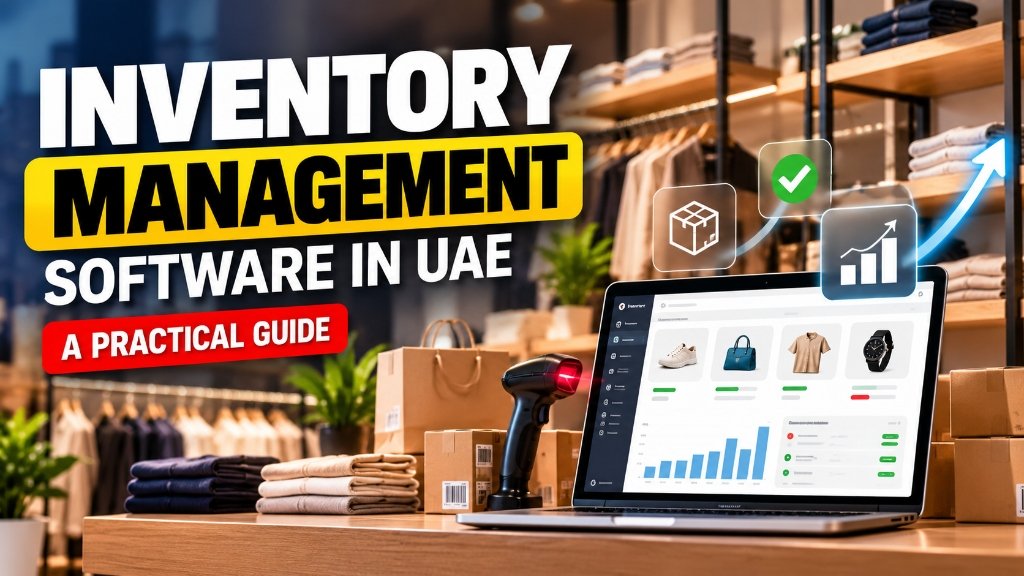
Inventory management software in the UAE is a connected retail operations system that synchronises real-time stock availability across physical branches, warehouses, e-commerce stores, and marketplaces (such as Amazon and Noon). Rather than functioning as an isolated spreadsheet or stock field, modern inventory platforms like ElintOm unify POS billing, barcode tracking, automated reorder thresholds, and channel allocations into one single source of truth.
For UAE retailers, inventory management is no longer simply about knowing how many products are available in a store or warehouse. It is about ensuring the right products are available at the right locations, when customers want to buy them.
A retailer may operate physical stores in Dubai, a warehouse in Sharjah, an ecommerce website, and marketplace listings on platforms such as Amazon and Noon. As sales channels expand, managing inventory becomes increasingly complex.
A product sold in-store may still appear available online. A popular item may run out in one branch while remaining unsold in another. Excess inventory can occupy valuable warehouse space and tie up working capital. These challenges directly affect profitability, customer experience, and business growth.
This is where modern inventory management software becomes essential. Solutions such as ElintOm retail software, offered through Swasthe’s retail technology services, help businesses explore a more connected approach to inventory, POS, ecommerce, customer management, and retail operations.
This guide explains the essential features of inventory management software in the UAE, how connected inventory systems improve retail performance, and what businesses should consider before choosing a solution.
Why Inventory Management Matters for UAE Retailers
Inventory represents a substantial investment for many retail businesses. Every product sitting on a shelf or in a warehouse has a cost. When inventory is not managed effectively, retailers face several operational and financial challenges.
1. Lost sales due to stockouts
Customers expect products to be available when and where they want them. If an item appears available online but is out of stock when the order reaches the store, the retailer may need to cancel the order or delay fulfilment. Apart from losing the immediate sale, repeated stock availability problems can affect customer confidence and future purchases.
2. Excess inventory and blocked working capital
Ordering too much inventory can be as damaging as ordering too little. Slow-moving products occupy storage space, increase holding costs, and restrict the funds available for purchasing better-performing products. This is particularly relevant for fashion, electronics, beauty, and seasonal retail categories, where customer demand can change quickly.
3. Disconnected sales channels
Many retailers operate separate systems for POS billing, ecommerce, warehouse management, and marketplace orders. When these systems are not connected, employees spend time updating spreadsheets, reconciling quantities, and resolving discrepancies. A connected inventory management system helps businesses work with more consistent stock information across their operations. Compare the operational cost in ElintOm vs scattered tools.
4. Limited visibility into product performance
Knowing total sales is useful, but retailers also need to understand which products are selling, where demand is strongest, and how quickly inventory is moving. Without reliable inventory data, purchasing decisions often depend on estimates instead of actual sales patterns. Effective inventory management provides the foundation for better merchandising, purchasing, and retail planning. See also 15 signs stock is losing money in UAE retail.
Essential Features of Inventory Management Software in the UAE
Not every retail business needs the same inventory software. However, several core capabilities are important when evaluating a solution.
Real-time stock visibility
A connected inventory system should provide an accurate view of stock across stores, warehouses, and supported online channels. Retailers should be able to identify available stock, reserved quantities, and inventory held at individual locations. This helps store teams respond to customer enquiries, coordinate stock transfers, and reduce the risk of accepting orders they cannot fulfil.
POS and ecommerce integration
Inventory management becomes more effective when connected to the point-of-sale system and ecommerce platforms. For example, when a customer purchases a product at a physical store, the system should update the available quantity across connected channels according to the retailer’s inventory allocation rules. Learn more in our guide on POS versus inventory management software and Shopify POS inventory integration.
Similarly, online orders, cancellations, and returns should follow defined workflows that keep stock records accurate. The objective is to maintain consistent product availability information across the business.
Automated replenishment and stock alerts
Inventory software can help retailers identify products approaching their reorder levels. Rather than relying entirely on manual stock checks, purchasing teams can use stock movement, historical sales, supplier lead times, and minimum stock levels to guide replenishment. This supports better purchasing decisions and reduces the risk of avoidable stockouts.
Barcode-based inventory control
Barcode scanning supports accurate product identification during receiving, checkout, transfers, and physical stock counts. It reduces repetitive manual entry and helps employees maintain reliable product records. For retailers managing thousands of SKUs, barcode-based workflows can simplify daily inventory operations.
Inventory reporting and analytics
Effective inventory management requires more than a dashboard displaying stock quantities. Retailers should evaluate reporting capabilities covering:
- Inventory turnover: to understand how quickly products sell.
- Sell-through rates: to assess sales performance against available stock.
- Stock ageing: to identify slow-moving products.
- Stockout frequency: to evaluate product availability problems.
- Product and category margins: to support profitability decisions.
- Inventory accuracy: to compare recorded stock against physical counts.
These insights support more informed merchandising, purchasing, and operational decisions.
Different Retail Sectors Have Different Inventory Requirements
While retailers share common stock management challenges, inventory requirements vary considerably between industries.
Pharmacy and healthcare retail
Pharmacies require careful inventory control, particularly for products with expiry dates and batch identifiers. Relevant capabilities include batch-level tracking, expiry monitoring, product movement histories, and stock segregation. These features help pharmacy teams identify approaching expiry dates, investigate stock discrepancies, and improve stock rotation. Pharmacy-specific regulatory and traceability requirements in the UAE must also be assessed separately when selecting and configuring a system. See how pharmacies structure this in pharmacy software systems in Sharjah and UAE.
Fashion and apparel retail
Fashion retailers manage products across different sizes, colours, styles, and seasonal collections. A particular garment may be available in one size but unavailable in another. A system that tracks only the overall product quantity cannot provide sufficient visibility. Variant-level inventory management helps retailers understand demand at the individual SKU level. It also supports better replenishment, inter-store transfers, and markdown decisions for slow-moving collections.
Beauty, cosmetics, and lifestyle retail
Beauty and lifestyle retailers often manage extensive product catalogues with variations in shades, sizes, packaging, and product collections. Inventory visibility becomes especially important when products are sold through multiple channels or offered as part of promotional bundles. Depending on the product category, businesses may also require batch or expiry tracking. The right inventory platform should support these operational differences without making daily store management unnecessarily complex.
How Connected Inventory Management Improves Retail Profitability
The real value of inventory management software should be measured through business outcomes rather than the number of available features. Consider a fashion retailer operating three stores and an ecommerce website. A particular footwear style is selling quickly in one branch but moving slowly in another.
Without reliable inventory visibility, the purchasing team may reorder the product even though sufficient stock is available elsewhere in the business. With connected inventory information, the retailer can identify this imbalance and consider transferring existing stock before placing a new purchase order.
This creates several potential benefits:
- Better working capital management: Existing inventory can be utilised more effectively before committing funds to additional purchases.
- Fewer missed sales opportunities: Store teams can identify where popular products are available and coordinate replenishment or transfers.
- Lower operational overhead: Connected records reduce manual reconciliation and repeated data entry.
- Improved customer experience: More accurate availability information helps businesses provide reliable delivery and collection options.
- More informed purchasing: Managers can analyse product movement and demand across locations instead of treating every branch independently.
These improvements depend on accurate data, appropriate system configuration, and consistent operational processes. Inventory software provides the visibility and controls needed to support better decisions. The commercial value comes from how effectively retailers use that information.
Why Inventory Management Must Be Connected to Retail Growth
Inventory management is often treated as a back-office operational function. In reality, it directly influences marketing effectiveness, ecommerce performance, and customer retention.
Consider a retailer launching a digital advertising campaign for a popular product. The campaign generates website traffic and customer enquiries. However, if the ecommerce platform does not reflect actual stock availability, customers may discover that the promoted product cannot be delivered. The retailer has spent money generating demand that the business cannot fulfil. That pattern is analyzed in why retail ads fail when inventory is disconnected.
Connecting inventory with ecommerce, POS, and retail operations helps reduce this disconnect. It also enables better coordination between marketing, merchandising, and store management. For example, sales and inventory movement data can help retailers identify products suitable for promotion, recognise slow-moving categories, and plan campaigns around available stock.
When inventory information is connected with customer and transaction data, businesses can also develop more relevant retention and cross-selling activities. This is why inventory management should form part of a broader retail technology strategy rather than operate as an isolated software function.
How to Choose the Right Inventory Management Software in the UAE
Choosing inventory software requires more than comparing subscription prices or checking feature lists. Retailers should evaluate how well each solution addresses their actual operational challenges.
- Identify your inventory management challenges: Begin by reviewing the problems affecting daily operations. Are store and ecommerce stock quantities inconsistent? Do employees spend time reconciling spreadsheets? Are stockouts occurring despite sufficient stock at other locations? Understanding these issues helps establish clear software requirements.
- Evaluate integration capabilities: Assess how the proposed software connects with existing POS, ecommerce, accounting, warehouse, and marketplace systems. Ask vendors to demonstrate real transaction workflows rather than relying on general integration claims. Check our omnichannel retail UAE integration architecture.
- Consider business scalability: A solution suitable for a single outlet may not automatically support a growing network of stores, warehouses, and online channels. Consider future requirements such as additional branches, larger product catalogues, more users, and new sales channels.
- Review implementation and support: Software implementation often involves product data cleaning, opening stock migration, workflow configuration, and staff training. Confirm the implementation scope, vendor responsibilities, available support, and process for resolving integration issues.
- Understand the total cost of ownership: Consider software subscriptions or licences, integrations, configuration, training, hardware, maintenance, and future expansion. The lowest initial price may not always result in the lowest long-term operating cost.
- Test actual retail workflows: Before committing, ask the vendor to demonstrate a complete inventory journey. For example, receive stock from a supplier, allocate inventory to two branches, complete an in-store sale, reserve an online order, process a return, and review the updated stock report. This practical assessment is often more useful than a presentation of software features.
ElintOm: Connecting Inventory Management With Retail Operations
For retailers managing multiple stores, ecommerce channels, and growing product catalogues, inventory management works best when it is connected to the wider retail operation.
ElintOm is a retail management platform that brings together inventory, POS, order management, customer management, and operational reporting within a connected retail environment. Through its retail technology services, Swasthe helps UAE retailers evaluate ElintOm as part of a broader approach to improving store operations, ecommerce connectivity, and business performance.
Bringing retail operations together
Retailers often experience inefficiencies because information is spread across separate systems. Store transactions are recorded in one platform, ecommerce orders in another, and inventory quantities are maintained through spreadsheets or independent stock software. ElintOm provides an integrated retail technology approach that can help businesses reduce these operational gaps.
Depending on the configuration and integrations selected, retailers can evaluate how inventory records connect with POS transactions, ecommerce orders, customer information, and operational reporting. This supports more consistent information across business functions and reduces dependence on disconnected processes.
Supporting better stock decisions
Inventory visibility becomes more valuable when retailers can connect it with sales activity and product movement. For example, a multistore retailer needs to understand which products are selling quickly, where inventory is available, and when replenishment or inter-store transfers may be required. Connected retail systems provide a foundation for these decisions by bringing relevant operational information together. The objective is to help retail teams spend less time reconciling information and more time making decisions that improve availability, efficiency, and customer experience.
ElintOm as part of a broader retail growth strategy
Technology alone does not guarantee better business performance. A retailer must also consider product data accuracy, purchasing practices, stock allocation rules, employee training, and reporting requirements. Swasthe’s approach connects technology evaluation with these wider operational and commercial considerations.
Rather than treating inventory software as a standalone purchase, businesses can assess how ElintOm fits into their retail technology environment and supports their longer-term growth requirements. Retailers interested in understanding its capabilities can explore ElintOm Retail Software Solutions through Swasthe.
When Should a Retailer Consider Upgrading Inventory Software?
Not every business needs to replace its existing inventory management system. However, upgrading or integrating existing technology may be worth considering when operational challenges begin affecting efficiency or growth. Common indicators include:
- Frequent differences between recorded and physical stock quantities.
- Difficulty managing inventory across multiple branches.
- Online order cancellations caused by inaccurate availability.
- Manual reconciliation between POS and ecommerce systems.
- Limited visibility into slow-moving and fast-selling products.
- Difficulty generating reliable stock and performance reports.
The first step should be to identify whether these problems result from software limitations, poor integration, inaccurate product data, or inconsistent internal processes. In some cases, improving the existing system may be more effective than replacing it. The objective is to establish reliable inventory processes and technology that can support current operations and future growth.
Conclusion: Better Inventory Management Supports Better Retail Growth
Effective inventory management is fundamental to profitable retail operations. For UAE retailers expanding across physical stores, ecommerce websites, and marketplaces, inventory accuracy and operational integration become increasingly important.
The right inventory management software can help improve stock visibility, support purchasing decisions, reduce manual work, and create a more consistent customer experience. However, technology is only part of the solution. Retailers also need reliable product information, clear operational processes, and connected business systems.
At Swasthe, inventory management is approached as part of a broader retail growth and transformation strategy. With retail technology solutions such as ElintOm, businesses can explore how connected inventory, POS, ecommerce, and customer management systems support more efficient operations and informed decision-making.
Looking to improve inventory visibility and connect your retail operations? Connect with Swasthe to assess your current retail systems, identify opportunities for improvement, and explore how ElintOm can support your inventory management and retail growth requirements. Explore ElintOm Retail Software Solutions or book a diagnostic Free UAE Growth Audit.
Frequently Asked Questions
What is inventory management software?
Inventory management software helps businesses track, organise, and control stock across stores, warehouses, and connected sales channels. It supports stock receiving, transfers, replenishment, sales updates, barcode scanning, and inventory analytics in real time.
What is the best inventory management software for UAE retailers?
There is no single solution suitable for every retailer. The best choice depends on business size, retail industry, number of store locations, sales channels, integration requirements, and budget. Solutions like ElintOm provide an integrated operations platform bringing inventory, POS, and multi-channel order management together under UAE commercial and tax standards.
Can inventory software connect physical stores and ecommerce?
Yes. Systems with appropriate POS and ecommerce integrations synchronise stock movements immediately upon sale, keeping product availability consistent across brick-and-mortar branches, online storefronts (such as Shopify or WooCommerce), and regional marketplaces like Amazon and Noon.
Can inventory management software reduce stockouts?
Inventory software reduces avoidable stockouts through real-time multi-location visibility, automated minimum reorder thresholds, supplier lead-time forecasting, and inter-branch stock rebalancing before high-demand items sell out.
What is ElintOm retail software?
ElintOm is an enterprise retail operations and management platform designed to connect inventory control, point of sale (POS), multi-channel orders, customer management (CRM), and operational financial reporting within a unified architecture. UAE retailers can evaluate and implement ElintOm through Swasthe.
Is ElintOm suitable for multistore retailers?
Yes. ElintOm is built specifically for multistore and omnichannel retail operations, offering branch-level stock allocation, centralised warehouse distribution, inter-store transfer tracking, and aggregated management analytics across Dubai, Abu Dhabi, Sharjah, and other emirates.
How does inventory management software handle UAE VAT compliance?
In the UAE, inventory systems must record purchases and sales with accurate 5% VAT calculations, issue FTA-compliant tax invoices, track input tax on supplier imports, and generate auditable stock valuation reports required for Federal Tax Authority filings.
What is the difference between periodic stock counts and perpetual inventory management?
Periodic inventory relies on periodic physical counts (monthly or annual) to update inventory records, leaving businesses blind to stock levels between counts. Perpetual inventory software updates stock continuously with every barcode scan, sale, return, or transfer, ensuring 24/7 inventory accuracy.
How do batch tracking and expiry date monitoring work for pharmacies and cosmetics?
For pharmacies, healthcare clinics, and cosmetics retailers, inventory software tracks individual batch numbers alongside manufacture and expiration dates. Pickers and cashiers are guided by FEFO (First-Expired, First-Out) logic, preventing expired stock from reaching customers and minimising write-offs.
How does barcode scanning streamline warehouse and store stock management?
Barcode scanning eliminates manual typing errors during goods receiving, putaway, shelf stock replenishment, and checkout. Handheld mobile scanners also allow staff to perform rolling cycle counts without shutting down stores or distribution centres.
How does inventory software prevent overselling on Amazon.ae and Noon?
Modern inventory software uses unified channel ledgers and safety buffers. The moment an item is purchased in a Dubai mall store or on a website, the software automatically decrements available-to-sell quantities across Amazon.ae and Noon feeds, preventing costly order cancellations and marketplace account penalties.
What is landed cost calculation and why is it important for UAE importers?
Landed cost calculates the complete cost of an item upon arrival in your UAE warehouse, including initial supplier price, ocean/air freight, customs tariffs, port handling charges, local haulage, and insurance. Accurate landed cost tracking ensures retailers price items profitably and understand true gross margins.
How can UAE retailers get started with an inventory systems audit from Swasthe?
Retailers can request a Free UAE Growth Audit or an ElintOm demonstration through Swasthe. Our team diagnoses stock discrepancies, channel disconnections, and till bottlenecks to outline an actionable systems roadmap.