

















































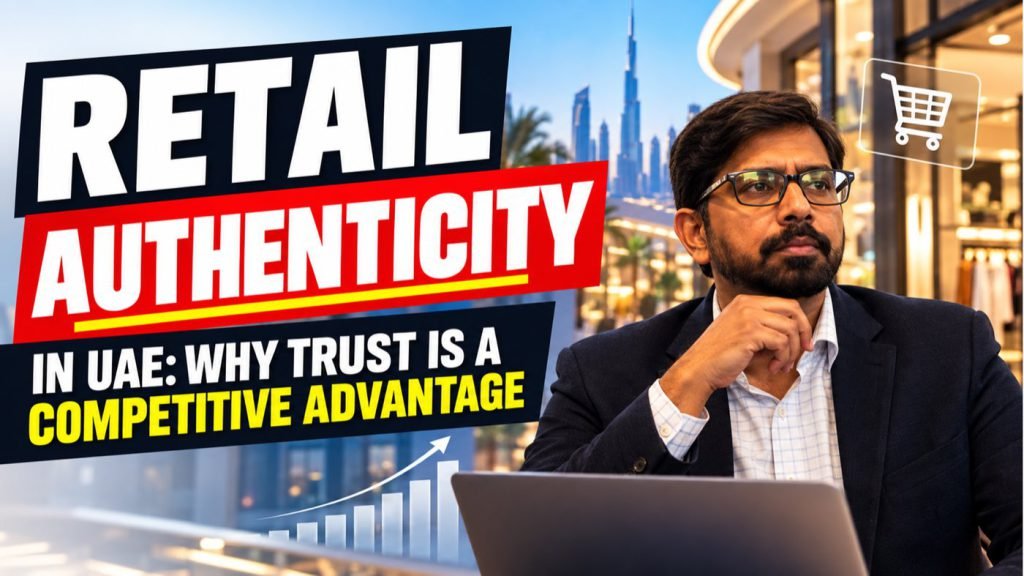
Retail authenticity in the UAE is the consistency between what a retailer promises, what the website and WhatsApp show, what the system records, and what the customer gets in the store or on delivery.
A customer may see an Instagram ad, check the website, ask on WhatsApp, then visit. If the price differs, the SKU is out of stock, the reply is slow, or the team has not heard of the promotion, the leak is not “more ads”. It is the gap between the message and the operation. Shoppers in the UAE move quickly between the store, the site, a marketplace and WhatsApp. The practical test of retail authenticity UAE retailers should run is whether the till still matches the message.
What does retail authenticity mean in the UAE?
Retail authenticity is the consistency between what a retailer promises online and what customers actually experience across pricing, stock, service, fulfilment and physical stores.
It is more than real photographs or a friendly tone. It means:
- The advertised product is available
- The price shown matches the till
- The Instagram or WhatsApp promotion can be redeemed
- Website information is accurate
- The store team knows what was promised
- Delivery matches the expectation you set
In one line: the message, the system and the experience agree.
| Promise | Where it has to match | What a break looks like |
|---|---|---|
| Price | Ad, website and till | A different figure at the counter |
| Stock | Site, WhatsApp and the shelf | The advertised size is zero in the POS |
| Offer | Instagram, chat and the receipt | Staff have not heard of the code |
| Delivery | The time you stated | Silence after “fast delivery” |
Marketing promise → digital experience → store experience → customer trust
Why retail authenticity feels scarce online
Content is cheap to produce. Customers see more posts, not more brands they trust. Polished claims start to look the same. Reviews feel generic. The product video does not match the parcel.
When everything looks optimised, people look for signals that are specific and checkable. Authenticity is scarce because empty communication is abundant — not because retailers stopped talking.
The trust signals customers look for
A shopper may find a pharmacy on Google, compare on a site, check WhatsApp, read reviews, order, then visit. Each step either confirms the promise or breaks it.
- Accurate product information
- Clear, consistent pricing
- Genuine availability
- Fast, useful WhatsApp replies
- Honest delivery expectations
- Helpful after-sales support
- The same facts online and in-store
- A store visit that matches the ad
If the site promotes an out-of-stock SKU, confidence drops. If WhatsApp offers a discount the POS does not recognise, the experience feels disconnected. If “fast delivery” is followed by silence, repeat purchase falls. Alignment is the work.
What this means for UAE retailers
UAE retail is competitive and digitally active. A beauty shop, pharmacy, supermarket, wellness brand or pet store is not only competing with the unit downstairs. It is competing with marketplaces, social sellers, delivery apps and DTC brands.
Smaller retailers do not need to imitate a global brand. They need to be clear, consistent and useful. That matters most where trust is the product: pharmacy information, beauty ingredients, wellness claims, pet advice.
The practical opportunity: connect the marketing promise with operational reality. Ecommerce, POS, inventory, WhatsApp and reporting should not be separate stories. When they are, even good ads create friction. When they agree, trust is cheaper to keep.
How UAE retailers can build authenticity across digital channels
Treat authenticity as customer experience, not a branding workshop.
1. Make product information specific
Generic pages do not build confidence. Give accurate names, categories, prices, availability, images and the facts a shopper needs to decide. That also helps search engines match intent. See wellness product page discipline for the same rule on a catalogue.
2. Keep inventory, pricing and promotions aligned
Promoting what you cannot sell is the fastest way to lose trust. Align stock, price and offers across site and store. You cut cancellations and wasted ad clicks. The traffic you paid for arrives at an experience that can fulfil the line.
3. Use WhatsApp as service, not only broadcast
Customers ask about availability, fit, delivery, price and order status. Useful replies strengthen trust. Repeated irrelevant blasts do the opposite. For pharmacy-style chat, keep the same honesty as WhatsApp as a sales channel — service first.
4. Make advertising match what the store can deliver
Strong retail ads do not need exaggerated promises. They name a benefit you can deliver: stock, convenience, a real offer, delivery speed, specialist knowledge. The ad and the next step must be the same story. If checkout or stock is broken, fix that before you scale spend — the same lesson as ads that hit a broken checkout.
5. Use real customer feedback as operations data
Repeated questions usually mean unclear product copy. Repeated complaints usually mean delivery or service. Positive comments tell you what to protect. Do not treat reviews only as reputation management.
6. Use sales data to stay honest
Watch what sells, what stalls, what repeats, which offers work, where journeys drop, and which channels contribute. Decisions based on till and stock data keep marketing relevant. That is how authenticity becomes an operating habit, not a tone of voice.
Authenticity is an operational advantage
Customers judge outcomes. Did the product arrive? Was the price correct? Was it in stock? Did someone answer WhatsApp? Did the promotion work? Did the store match the ad?
More advertising will not fix a bad catalogue. More traffic will not fix false stock. More WhatsApp will not fix a messy inbox. More promotions will not create loyalty if the experience feels disconnected.
For UAE retailers, ecommerce, POS, inventory, customer records, marketing and reporting have to support one journey. Integrated systems reduce the gap between what you say and what you can deliver.
Where Swasthe fits
Swasthe’s retail growth framework uses four stages: Audit, Build, Connect and Grow.
- Audit — find where customers are lost and where trust breaks.
- Build — fix the ecommerce path, content, campaigns and journeys that affect conversion.
- Connect — join ecommerce, POS, inventory, WhatsApp and reporting.
- Grow — use the cleaner experience and data to acquire, convert and retain.
We look at ecommerce decision quality, whether campaigns promise what the store can fulfil, whether WhatsApp helps or nags, whether POS and inventory tell the same story, and whether you can see what sells. If you have traffic but not sales, or online and offline disagree, start with the gaps. Then grow around them. Pair this with footfall that you can attribute so trust and measurement sit on the same page.
Measurement and trust are the same job. A coded visit is covered in Dubai retail footfall. A conversation ad still fails if the branch cannot fulfil it: ChatGPT Ads for UAE retailers. A card payment that does not update stock is the same break: online payment gateways in the UAE.
FAQ: retail authenticity UAE
Is retail authenticity just using real photos?
No. Photos help. Authenticity is whether price, stock, service and delivery match the promise.
Can a small UAE store compete with marketplaces on authenticity?
Yes, on reliability and response — not on catalogue size. Be the retailer whose WhatsApp and till tell the same story.
What should I fix first?
Usually stock and price alignment on the SKUs you advertise, then WhatsApp response time, then staff briefing on live offers.
Does Swasthe run authenticity as a branding project?
No. We treat it as a growth leak: message, system and experience. Request a Retail Growth Audit if those three disagree.
Sources
- Google Business — the public listing has to match hours, location and what the store actually sells. Reviews on that listing are operations data, not a slogan.
This article does not cite a survey or a percentage. Where a number would help, we do not have a verified set large enough to publish.
Author
Written by Swasthe editorial. Swasthe Middle East LLC is a UAE retail growth and business systems partner. We work with pharmacies, wellness, specialty retail and service businesses across Dubai, Sharjah and the wider UAE.
Published: 25 September 2026. Last reviewed: 28 September 2026. Review again within 6–12 months.
Swasthe on LinkedIn · About Swasthe · Audit → Build → Connect → Grow
If the customer experience does not match the message, that is a retail authenticity UAE problem, not a media problem. Request a Retail Growth Audit and bring one advertised SKU plus the till price for that SKU.