


















































Online order fulfilment for a UAE retailer is the path from a captured payment to a courier scan and a WhatsApp the customer believes. The order gets stuck in the gaps: stock was not locked, nobody named the branch that has the unit, the pack bench never saw the order, or the rider received an address without a paid-or-COD flag.
Last-mile delivery is the visible part. The leak usually starts earlier, between the website or marketplace and the shelf. If you are already packing every evening and still refunding, read the sequence below against one real order before you change courier.
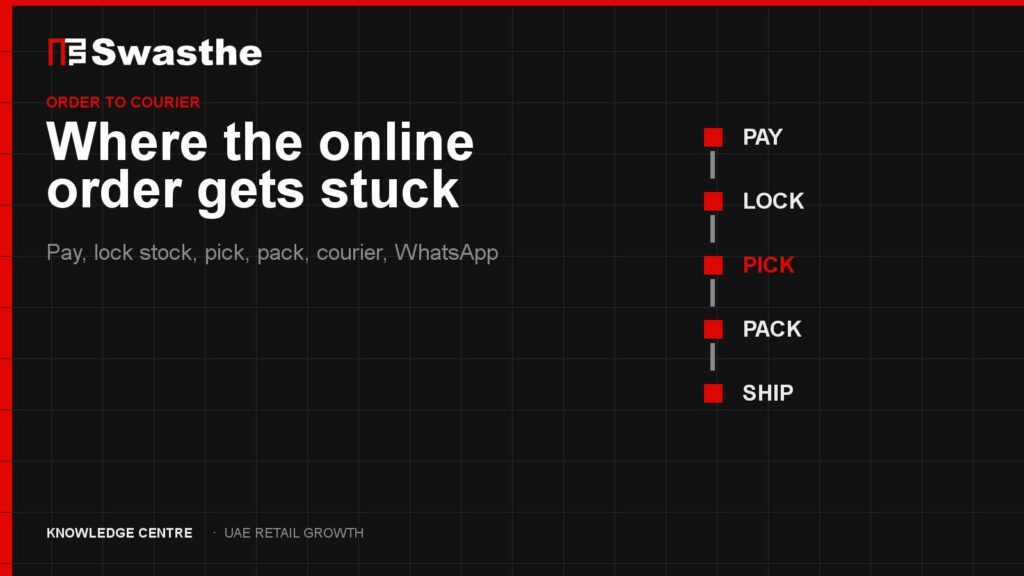
The sequence that has to stay in one line
A completed retail order in Dubai or Sharjah does this, in order:
- Payment. The card, wallet or payment link captures. The order is marked paid in the queue the packer watches. Pending-looking orders do not get picked “just in case.”
- Stock lock. The unit is reserved. Shopify, the till and any marketplace stop offering it.
- Pick location. The ticket names the warehouse or the branch that actually has the unit and can meet the cut-off. A Marina pickup promise is not fulfilled from a Sharjah industrial rack unless you told the customer that.
- Pick. Someone walks to that bin during a staffed hour, not after the mall closes.
- Pack. The right SKU, the invoice or receipt the customer expects, and a label with a phone number that works.
- Courier. The rider gets the address, the building and apartment, the emirate, and whether the parcel is prepaid. Jeebly and other UAE last-mile partners carry the parcel. They cannot invent a SKU you did not pack.
- WhatsApp. The customer hears that it is packed, then that it is with the rider, then that it arrived. Silence reads as failure even when the van is on time.
Break any step and the later steps look like a courier problem. They often are not.
Where UAE orders actually stall
Paid status never reaches the bench. The gateway captured the money. The order screen still says unpaid, so the team waits. Finance and the packer now disagree about a real sale. How gateways differ on that handoff is in online payment gateways UAE. Swasthe’s payment partner is uTap. A personal payment link outside that merchant account will not show up as paid in the queue.
Stock was not locked. The website sold a unit the cashier also sold twenty minutes later. You pay the customer back and you pay the picker’s time. That failure is inventory, documented in Shopify, POS and inventory and in the 15 stock signs.
The wrong location is chosen. Same-day language that is true for Dubai Marina and false for Al Ain creates a one-star chat even when the rider met the real SLA. Print emirates and cut-offs on the product page. Friday and mall closing hours belong on that page, not only in a policy footer.
The order lives in a chat. WhatsApp orders that are never typed into the queue do not reserve stock and do not get a label. They also vanish when the staff member who “has it on their phone” goes off shift. The wider channel picture is omnichannel retail.
The handoff to the rider is incomplete. No apartment number, no phone, COD on a prepaid order, or a SKU the packer substituted without telling the customer. The courier is then blamed for a parcel that was never packable.
Branch pick versus warehouse ship
Not every branch should ship. A mall counter at 7pm is a poor pick face: the queue is the job, the stock room is upstairs, and the rider cannot access the service corridor. Choose ship-from locations on purpose.
- Pickup: only branches that can have the unit at a named counter during posted hours.
- Delivery: a warehouse or a back room that is staffed up to the cut-off you advertise.
- Marketplace: the same locations, or you will confirm an Amazon.ae or Noon order you cannot reach before the marketplace’s own promise.
The day-to-day version of this queue is already on retail operations for online orders. Use that piece if you are designing the bench. Use this piece if you are trying to see which step drops the order.
The stuck order is a disconnected sequence
The architecture observation: last-mile performance follows the quality of the handoff. A courier with a complete, paid, reserved parcel is a different problem from a courier sent to collect a SKU that was never locked. Changing rider companies while the queue is still four tabs will reproduce the same WhatsApp apologies.
ElintOm is one retail operations platform for the part before the rider: centralised orders, warehouse and store stock, and fulfilment routed to the location that has the unit. Jeebly and other couriers remain the last-mile partners. ElintOm does not replace the van. Payments stay with the gateway and with uTap. The platform’s job is to make the parcel true before the scan.
What to fix before you renegotiate delivery rates
Pull ten recent orders: five that arrived as promised and five that became refunds or angry chats. Mark the first broken step. You will usually see a cluster, not a random spread.
- If payment status is the cluster, fix capture and the queue before the pack process.
- If stock lock is the cluster, connect available-to-sell. Do not add same-day zones.
- If location is the cluster, shrink the promise to branches that can pick.
- If the label is the cluster, fix address fields — building, apartment, emirate — on the checkout the customer actually uses.
- If the courier scan is the cluster and the parcel was complete, then talk to the last-mile partner about SLA, not about your theme.
That is Audit, then Build the promise, then Connect the queue, then Grow delivery zones and ads. Start a Free Growth Audit when you want those clusters separated from a general “sales are down” brief. Continue into how the pack bench should run when the sequence is clear and the bench is the remaining design. The checks that sit upstream, including demand and the till, are the 25-point retail growth audit.
FAQ: online order fulfilment UAE
What is online order fulfilment for a retailer?
Everything after the customer pays and before they hold the product: reserve the unit, choose the location, pick, pack, hand to the courier, and tell the customer.
Why do orders get stuck after payment?
The usual reasons are an unpaid-looking status, stock that was never reserved, a branch that cannot pick, or an address the rider cannot use. The courier is the last step, not the first suspect.
Should every store fulfil Shopify orders?
No. Fulfil from locations that are staffed for picking up to the cut-off you print on the site. A busy mall till is often the wrong ship-from point.
How does WhatsApp fit last-mile?
Customers in the UAE expect a message when the order is packed and when it is out. That message has to match the parcel. A cheerful template on a delayed, unpaid or substituted order makes the complaint worse.
What should I open next?
If you need the bench design, open retail operations for online orders. If the stall is stock, open Shopify and POS inventory. If you want the whole leak named, start a Free Growth Audit.