



















































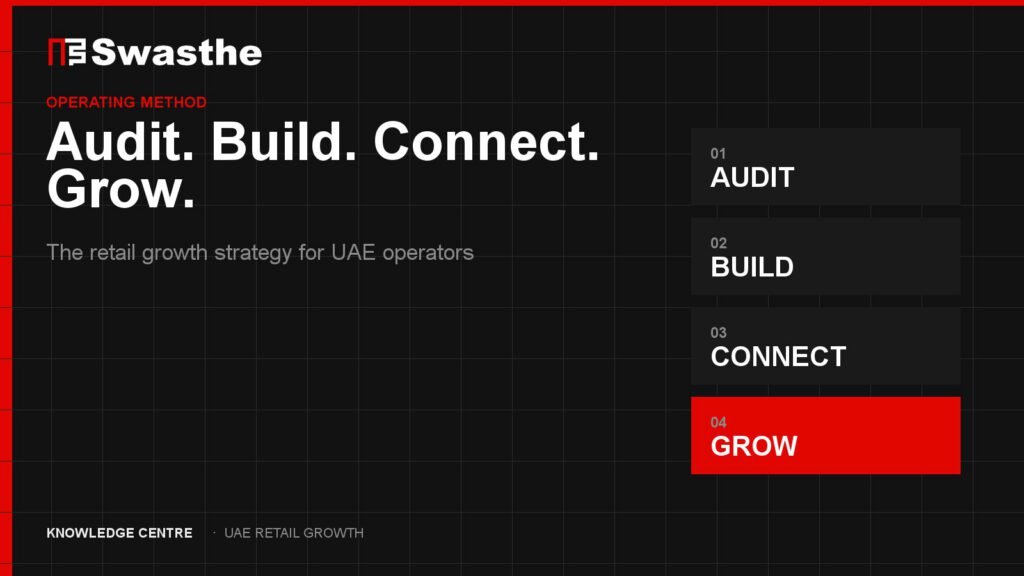
A retail growth strategy in the UAE is a sequence: find the leak, fix the path that takes payment, connect the till and the channels, and only then buy more demand. Audit, Build, Connect, Grow. Campaigns, SEO and marketplace pushes sit in the last step. They are tools. They are not the strategy.
Owners search for a growth plan when sales feel stuck and a vendor has offered ads, a new app or a second marketplace. The plan that starts there spends money on a path that may already drop the order. The plan that starts with the leak spends the next month on the constraint that is actually capping Saturday.
What the strategy has to put in order
UAE retail growth is a stack of facts, not a slogan. A customer in Dubai or Sharjah has to find you, understand the offer including VAT, pay, receive the unit from a real bin, and hear from you again when a repeat makes sense. Each of those facts can fail on its own.
The strategy names the first failure and refuses to scale the later steps until that failure is boring. Boring means five real orders in a row match the ad click, the settlement, the shelf and the WhatsApp. Anything short of that is still Audit.
Audit: name the leak
Audit asks which of four piles is losing the money.
- Demand. The right people cannot find the store, the Maps pin or the SKU.
- Conversion. They find it and cannot finish: page, checkout, wallet, payment status.
- Operations. They pay, and stock, branch or courier cannot keep the promise.
- Follow-up. They buy once, and the receipt never becomes a second visit.
The practical list is the UAE retail growth audit: 25 checks before more ad spend. The way a healthy-looking ads account still misses the till is why retailers lose sales when ads are working. The four piles, as a map you can share with a team, are revenue leaks.
Do not skip this because a platform already shows a cost per purchase. That number is only as honest as the event you gave it.
Build: make the commerce path hold a sale
Build is the store, the catalogue and the checkout. A product page that hides delivery cut-offs, a theme that dropped Apple Pay, a price that disagrees with the till by the VAT line — these are build failures. They are fixed in the shop, not in a media plan.
For a website, use the ecommerce audit checklist and the broken checkout tests. Buy one SKU yourself on an iPhone. If you will not complete the purchase, a stranger will not either.
Build also includes the physical promise: mall hours on the door match Google, pickup names a real counter, and Friday cut-offs are true for the emirate you named.
Connect: one number for stock, payment and the customer
Connect is the commercial centre of the strategy. UAE retailers rarely have one system. They have a till, Shopify, sometimes Amazon.ae, sometimes Noon, WhatsApp, a courier and a sheet.
Connection means:
- One available-to-sell number, tested in Shopify, POS and inventory and across channels in omnichannel retail.
- A paid status that reaches the pack bench, then the rider, in online order fulfilment.
- A receipt that reaches WhatsApp and loyalty, in CRM for retail.
The map of which system owns which job is the retail technology stack. ElintOm is one retail operations platform inside that stack — POS, inventory, orders, customers, loyalty and the ecommerce channels it documents. It belongs in Connect when the leak is the store ledger. It is not the strategy, and it is not a substitute for Shopify, Amazon.ae, Noon or the courier.
Grow: demand and repeat, after the path converts
Grow is what most “retail marketing strategy” articles open with. Here it is last, on purpose.
- Local visibility and footfall, once the pin, the hours and the shelf agree.
- Google and Meta, once five paid tests match the till.
- Marketplace growth on Amazon.ae and Noon, once those listings cannot oversell the shelf. That work sits on marketplace growth.
- Loyalty and replenishment, once the receipt is in the customer record. The offer itself is POS loyalty.
If demand is the leak you named in Audit, Grow is the right next project, on retail growth. If operations was the leak, Grow waits. Extra reach on an oversell is a faster refund.
Starting at Grow is how the year gets expensive
The failure mode is familiar. A retailer in Dubai signs a monthly ad retainer, launches a Noon store in the same month, and buys a CRM because a deck said the stack was incomplete. None of those projects checked whether the Marina till and the website share a quantity. By week six the team is managing cancellations. The strategy review blames creative.
The alternative sequence is shorter. One branch. Five SKUs. The 25 checks. Repair the first failed pile. Connect the number that was lying. Then raise spend on the SKUs that survived the test. That is a retail growth strategy a supervisor can run without a new slogan.
One month, one branch, in order
A practical month for a specialty retailer looks like this. Week one is Audit on the busiest branch and the website: the 25 checks, five SKUs, one iPhone purchase. Week two is Build on whatever failed in public — the page, the wallet, the hours, the VAT line. Week three is Connect: the till sale must change the number the site can sell, and a paid web order must appear where the packer looks. Week four is Grow only on the SKUs that passed week three. If week three failed, week four is another connection week, not a new audience.
That month is the strategy. A quarterly plan that opens with a channel launch and fits “fix the till” into a footnote will spend the quarter on refunds. Put the footnote in week one.
What to do next
If you have not marked the leaks, start with the 25 checks and the framework that holds Audit, Build, Connect, Grow in one place. If you already know which pile is failing and you want it confirmed against the way you actually sell, start a Free Growth Audit. The audit is the first move of the strategy. It is not a substitute for reading the pile you are in — stock, checkout, follow-up or demand — in the article that matches it.
FAQ: retail growth strategy UAE
What is a retail growth strategy?
A sequence for increasing sales without scaling a leak: audit the constraint, build the path that takes payment, connect stock and customers, then grow demand and repeat purchase.
Should I start with ads or with software?
Start with the leak. Ads first when strangers cannot find an offer you can already fulfil. Software first when the till, the site and the warehouse disagree. Both at once usually means neither gets a clean test.
Where do Amazon and Noon fit?
They are Grow channels after available stock and the pack bench can absorb another order source. Opening them to “be present” while the shelf and the site disagree adds cancellations.
How long should Audit take?
One busy branch and the website, one week, five SKUs. A group-wide study that never buys a test unit on an iPhone is not an audit.
What is the first link to open?
The 25-check retail growth audit. If you already know the pile, start a Free Growth Audit and keep the matching article — stock, Shopify, fulfilment or CRM — open beside it.
What are the four core pillars of the Audit, Build, Connect, Grow retail growth framework?
1) Audit: identify hidden revenue, inventory, and conversion leaks. 2) Build: fix product pages, checkout paths, and counter billing. 3) Connect: unify POS, inventory, payments, and CRM. 4) Grow: scale advertising, marketplace expansion, and customer retention.
Why must operational and checkout leaks be fixed before increasing marketing advertising spend?
Increasing ad spend into a broken retail operation simply accelerates losses: ad spend generates traffic that bounces on broken checkouts, sells out-of-stock items, and triggers negative customer reviews.
How should a UAE retail founder determine whether to prioritize physical expansion or e-commerce?
Analyze your unit economics. If physical stores generate strong cash flow and high repeat visits, expansion into complementary mall catchments makes sense. If digital infrastructure is robust, scaling e-commerce offers broader GCC reach with lower capital expenditure.
What role does customer lifetime value (LTV) play in building a sustainable retail growth strategy?
Sustainable growth is built on retention, not endless customer acquisition. Lifting repeat purchase frequency by 10% through loyalty and WhatsApp CRM often increases bottom-line operating profit by over 30%.
How does gross margin protection influence promotional and discounting strategies during peak sales?
Deep discounts can double revenue while wiping out operating profits. Build promotions around value-add bundles, minimum spend thresholds, and seasonal clearance rather than unconditional price slashes on hero SKUs.
Why do disconnected business systems sabotage retail scalability as order volumes increase?
Siloed software requires manual data re-keying, introduces inventory sync delays, creates reporting blindspots, and consumes valuable staff time that should be focused on serving customers.
What key performance indicators should a retail board review monthly to ensure healthy growth?
Review net revenue growth, blended gross margin, customer acquisition cost (CAC), customer lifetime value (LTV), inventory turnover ratio, and net operating contribution across sales channels.
How does ElintOm provide the business systems foundation required to execute a growth strategy?
ElintOm serves as the operational engine, combining multi-store POS billing, inventory synchronization, e-commerce order routing, and financial reporting into a scalable platform designed for UAE retail growth.
How can a UAE retail brand partner with Swasthe to audit and accelerate its retail growth engine?
Request a Free UAE Growth Audit or consult our Retail Growth specialists. We conduct an end-to-end diagnostic of your demand channels, counter operations, inventory truth, and systems architecture to build a profitable growth roadmap.