



















































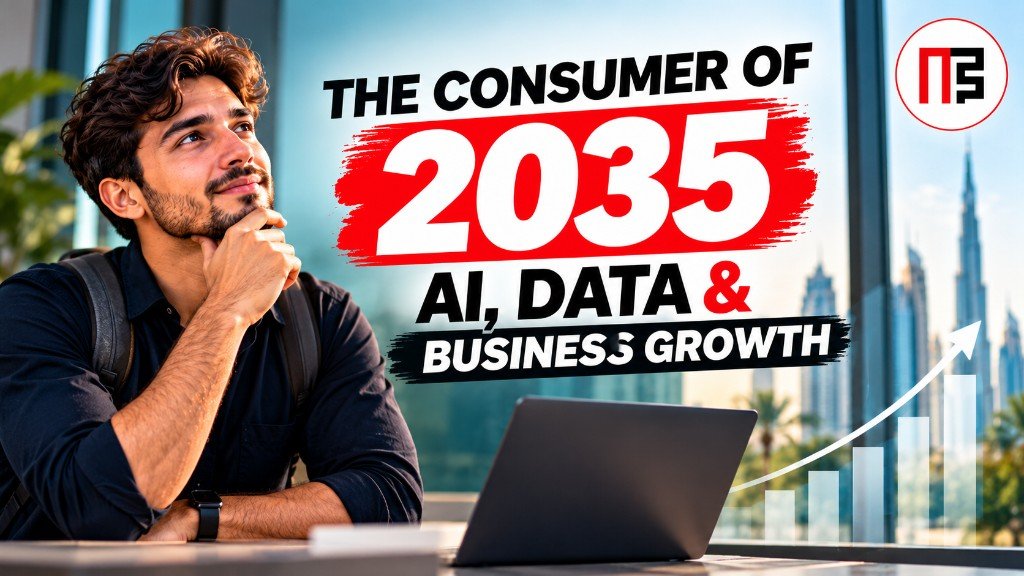
The businesses that lead in 2035 may not necessarily be the ones spending the most on marketing, opening the most stores or adopting the latest technology. They may be the ones that understand their customers better, make faster decisions, connect their operations and adapt more effectively to change.
For retailers, ecommerce brands and service businesses, this raises an important question: Are you building a business that can meet the expectations of tomorrow’s consumer, or are you still operating around yesterday’s assumptions?
The consumer of 2035 is still a future proposition. Nobody can predict every preference, technology or buying behaviour that will emerge over the next nine years. However, businesses do not need to predict the future perfectly to prepare for it. They need to build the capabilities that allow them to understand change, respond intelligently and continue creating value.
That preparation requires a broader view of business investment. Financial capital and human capital will remain essential. But alongside them, businesses increasingly need connected data, intelligent algorithms, AI agents and people who can work effectively with these capabilities.
The competitive advantage will not come from owning these resources independently. It will come from making them work together.
1. The consumer is changing. Is the business changing with them?
Customer expectations are shaped by every experience they encounter, not just the experiences within a particular industry.
A customer who receives personalised product recommendations online may begin to expect more relevant recommendations elsewhere. Someone accustomed to real-time order updates may become less tolerant of uncertainty when purchasing from another retailer. A customer who can resolve an enquiry quickly through an intelligent digital assistant may question why another business requires repeated calls and messages.
These expectations are not universal, and not every customer wants a fully automated experience. Convenience, trust, human assistance, price and product quality will continue to influence buying decisions.
Nevertheless, businesses must prepare for a marketplace in which customers can increasingly expect relevant experiences, convenient interactions and consistent service across channels.
Consider a customer buying skincare products from a pharmacy.
The customer might discover a product through social media, compare options on a marketplace, check availability on the pharmacy’s website and finally purchase from a physical store. After the purchase, the customer may expect useful product information, timely delivery updates and relevant replenishment reminders.
From the customer’s perspective, these are connected parts of one buying journey.
From the business’s perspective, however, they may involve separate advertising platforms, ecommerce systems, inventory records, payment tools, customer databases and store operations.
The gap between the customer’s experience and the business’s internal operations is where tomorrow’s competitive challenges are likely to emerge.
A business can invest heavily in customer acquisition and still lose customers because its stock information is inaccurate, its service is inconsistent or its follow-up is poor. Increasing demand does not automatically create a better business.
Preparing for the consumer of 2035 therefore begins with understanding the entire customer journey, from discovery and consideration to purchase, fulfilment, retention and advocacy.
2. Human capabilities will matter more, not less
The growing availability of AI may encourage businesses to think that technology alone will deliver the next competitive advantage. That is an incomplete view.
Technology can generate recommendations, analyse large datasets, automate repetitive tasks and support decision-making. But businesses still need people who understand the commercial context, recognise exceptions, question assumptions and take responsibility for outcomes.
As AI becomes more accessible, the differentiating factor may shift from simply having access to technology towards knowing how to use it effectively.
For a retail business, this could mean helping store managers interpret sales and inventory reports rather than simply generating more reports. For an ecommerce team, it could mean using AI-generated insights to improve product pages, pricing decisions and customer retention. For a service business, it could mean equipping employees to use customer data and automation without losing the personal attention that customers value.
The required capabilities will extend beyond technical proficiency.
Businesses will need people who can:
- Interpret information and distinguish useful insights from noise.
- Understand customer needs and changing buying behaviour.
- Work alongside AI tools and evaluate their recommendations.
- Redesign inefficient processes instead of merely automating them.
- Exercise sound judgment when technology produces uncertain or incorrect results.
- Protect customer information and maintain trust.
Leadership will be particularly important. Business owners and managers must understand where technology can create value, where human judgment remains essential and how to measure whether an investment is producing meaningful results.
This does not mean every employee must become a data scientist or AI specialist. It means people across the organisation should have the skills, information and authority needed to make better decisions.
The objective is not to replace human capabilities with AI. It is to strengthen human capabilities with AI.
3. Data will become a business capability, not just a reporting resource
Many businesses already collect substantial amounts of information. They have sales reports, website analytics, advertising dashboards, customer lists, inventory records and transaction histories.
Yet having data is not the same as having a data-driven business.
Information often sits in disconnected systems. Marketing teams measure campaign performance, finance teams review revenue, store managers monitor stock and customer service teams handle complaints. Each team may have useful information, but the business struggles to connect those insights into a coherent view of performance.
This creates a fundamental problem: decisions are made using incomplete information.
Imagine a retailer whose online sales are increasing.
At first glance, this appears to be positive growth. But a closer examination might reveal that popular products are frequently out of stock, marketplace orders are not synchronised with store inventory, delivery costs are rising and repeat purchases are declining.
The business is generating demand, but its operating model is struggling to convert that demand into sustainable profitability.
Without connected information, management may respond by increasing advertising expenditure. With better data, the business could identify stock availability, fulfilment efficiency, product profitability or retention as the more important constraints.
This is where data integration becomes commercially significant.
Businesses need to connect relevant information across:
- Sales channels, including physical stores, websites and marketplaces.
- Inventory, purchasing and fulfilment operations.
- Customer records, loyalty programmes and CRM systems.
- Marketing expenditure, leads, conversions and repeat purchases.
- Payments, revenue, costs and profitability.
The goal is not to collect every possible data point. It is to establish a reliable view of how the business acquires customers, converts demand, delivers value and generates revenue.
Data quality, consistency, ownership and governance matter as much as data volume. Poor information can produce poor decisions, even when sophisticated analytical tools are involved.
As businesses adopt more AI-powered systems, these foundations become even more important. An AI assistant cannot reliably answer questions about stock availability if the underlying inventory records are inaccurate. A customer recommendation system cannot consistently personalise experiences if customer information is fragmented or outdated.
Before asking AI to make a business smarter, businesses must make their information usable.
4. Algorithms will help businesses move from observation to prediction
Traditional business reporting largely explains what has already happened.
How much did the store sell last month? Which campaign generated the most enquiries? Which products sold fastest? How many customers returned?
These questions remain important. However, competitive advantage increasingly comes from using historical and current information to anticipate what might happen next and decide what to do about it.
Algorithms can help identify patterns, estimate future demand, recommend relevant products, segment customers and highlight unusual changes in performance.
For a retailer, demand forecasting could help anticipate which products may sell faster during a seasonal period. Better recommendations could make product discovery more relevant. Customer analysis could identify groups that may respond to a loyalty offer or replenishment reminder.
For an ecommerce business, analytical models could help identify products with high traffic but low conversion, customers at risk of becoming inactive, or campaigns that generate revenue without adequate contribution margins.
For a service business, lead scoring and predictive analysis could help prioritise enquiries that need timely attention.
These capabilities do not guarantee accurate predictions. Models depend on data quality, appropriate assumptions and changing market conditions. Businesses must monitor their performance and ensure that automated recommendations do not become unquestioned decisions.
The practical opportunity is to move from reactive management towards more informed anticipation.
Instead of asking only, “What happened to sales?”, a business can begin asking:
- What is likely to affect sales next?
- Which products or customers need attention?
- Where are we likely to lose revenue?
- Which operational constraint could limit growth?
- What action is most likely to improve the outcome?
This changes the role of analytics from producing reports to supporting business decisions.
It also changes the meaning of competitive intelligence. A business does not need to predict every move a competitor makes. It needs to understand its own performance, recognise emerging patterns and respond more effectively.
5. AI agents could change how business work gets done
AI assistants have already made it easier to draft content, summarise information, answer questions and support research. AI agents extend this direction by enabling systems to work through multi-step tasks, use permitted tools and take actions within defined boundaries.
The distinction is important.
An assistant might summarise a report about declining customer retention. An appropriately configured agent could potentially analyse permitted customer data, identify customers who meet predefined criteria, prepare relevant follow-up messages and send them for approval before delivery.
In a retail environment, potential applications include:
- Responding to routine customer enquiries using approved information.
- Supporting lead qualification and follow-up.
- Preparing daily sales and operational summaries.
- Flagging inventory discrepancies or potential stock shortages.
- Helping coordinate routine ecommerce and marketplace workflows.
- Identifying customers eligible for relevant retention campaigns.
The exact level of autonomy will depend on the technology, integrations, business rules and risk involved. Financial transactions, sensitive customer decisions and consequential operational actions may require explicit approval and additional safeguards.
Businesses should therefore avoid treating AI agents as autonomous employees that can simply be switched on and left unsupervised.
Successful implementation requires clearly defined tasks, reliable information, permissions, exception handling, performance monitoring and human accountability.
The best starting point is often a repetitive, well-understood workflow where the cost of errors is manageable and the outcome can be measured.
For example, a business might begin by automating the preparation of a daily sales summary before progressing to more complex actions involving customer communications or inventory management.
The question should not be, “Where can we use an AI agent?”
A better question is, “Which recurring business problem can we solve reliably with the help of AI, and how will we measure the result?”
This approach connects AI adoption to business value rather than novelty.
6. The real opportunity lies in connecting marketing, customers and operations
One of the biggest mistakes businesses can make is treating growth as a marketing problem alone.
Marketing creates awareness and demand. But the value of that demand depends on everything that follows: product availability, pricing, conversion, payment, fulfilment, customer experience and retention.
When these elements operate independently, the business may spend more to generate customers without improving its ability to serve them profitably.
Consider three common situations.
Situation A: More enquiries, fewer conversions
A service business increases advertising and generates more enquiries. However, response times are slow, leads are not consistently recorded and follow-ups depend on individual employees remembering to act.
The apparent problem is lead quality. The underlying problem may be a disconnected lead-management process.
Connecting enquiry capture, CRM records, automated follow-up and sales reporting could improve the business’s ability to convert the demand it already generates.
Situation B: More orders, more operational pressure
An ecommerce brand increases marketplace sales, but inventory is updated manually. Products appear available after stock has been sold elsewhere, fulfilment teams struggle to keep up and customer complaints increase.
The apparent problem is operational capacity. The deeper issue may be that sales channels and inventory processes are not connected.
Improving inventory synchronisation, order workflows and operational visibility could help the business manage growth more effectively.
Situation C: More customers, limited repeat business
A retailer spends consistently on customer acquisition but has limited visibility into repeat purchases. Customer data is spread across different channels, and marketing messages are not sufficiently relevant.
The business may assume that it needs more advertising. Yet the greater opportunity could lie in retention, loyalty, customer service and more useful follow-up.
These examples illustrate a common principle: growth is a system, not an isolated activity.
The businesses best prepared for the future will not necessarily be those that automate the most processes. They will be those that understand how demand, conversion, customer relationships and operations influence one another.
That is particularly relevant to retailers operating across physical stores, ecommerce websites and marketplaces, where fragmented processes can quickly become a barrier to growth.
7. Resilience will be a competitive advantage
Competitiveness is often measured through growth, market share, revenue or profitability. These measures matter, but they do not tell the whole story.
A business may grow quickly while becoming increasingly dependent on a single acquisition channel, a small number of suppliers or manual processes that cannot scale.
Such a business may perform well under favourable conditions but struggle when customer behaviour changes, advertising costs increase, supply becomes unpredictable or a critical system fails.
Resilience is the ability to adapt, absorb disruption and continue operating effectively.
For a retailer, resilience might involve better visibility into stock, alternative sales channels, more accurate demand planning and the ability to communicate with customers when disruptions occur.
For an ecommerce brand, it could mean reducing excessive dependence on one marketplace, understanding customer profitability across channels and building stronger direct customer relationships.
For a service business, resilience could involve reliable lead records, documented processes, consistent customer communication and less dependence on one employee’s memory or availability.
AI and data can support resilience by improving visibility, detecting anomalies and helping teams evaluate alternatives. But technology alone cannot create a resilient business.
Resilience also requires sound financial management, capable people, operational discipline, cybersecurity, clear accountability and contingency planning.
The objective is not to eliminate uncertainty. It is to build a business that can respond to uncertainty without losing control of its core operations.
8. What should businesses in the UAE do now?
Businesses do not need to wait until 2035 to prepare. Nor do they need to invest in every emerging technology.
A more practical approach is to build readiness in stages.
Step 1: Understand the current business
Establish a clear picture of how the business acquires customers, converts demand, delivers products or services and generates repeat revenue.
Identify where information is missing, where processes depend on manual work and where performance is difficult to measure.
Step 2: Connect the essential systems
Prioritise the systems that influence everyday decisions. Depending on the business, these may include POS, inventory, ecommerce, marketplace management, payments, CRM, customer communication and reporting.
The objective is to reduce fragmentation and establish trustworthy information flows, not to implement technology simply because it is available.
Step 3: Build data and AI literacy
Help employees understand the information they use, the limitations of AI-generated recommendations and the importance of checking outputs.
Train managers to connect technology decisions with commercial outcomes such as conversion, customer retention, stock availability, operating costs and profitability.
Step 4: Start with measurable AI applications
Choose a specific problem with a clear baseline and a measurable outcome.
Examples include reducing the time required to respond to enquiries, improving the accuracy of sales reporting, identifying stock-out risks or making customer follow-up more consistent.
Test the application, monitor errors and assess whether it delivers sufficient value before expanding its use.
Step 5: Establish governance and accountability
Determine what information AI systems can access, which actions require approval and who is accountable for the results.
Protect customer information, apply appropriate access controls and review relevant legal, privacy and security requirements.
Responsible adoption is not a separate concern from growth. Customer trust is itself a business asset.
Step 6: Review readiness regularly
Customer expectations, technology and competition will continue to evolve. Businesses should periodically reassess their processes, systems, skills and investment priorities.
The objective is to create a repeatable capability for adaptation, rather than complete a one-time digital transformation project and assume the work is finished.
For UAE businesses, this approach offers a practical way to prepare for an increasingly connected, data-informed and AI-enabled commercial environment while remaining focused on today’s business realities.
9. The question is not how much technology you have
By 2035, AI tools may be widely accessible to businesses of different sizes. Many capabilities that currently require specialist teams could become easier to deploy.
If access to technology becomes less of a differentiator, the more important questions will concern implementation and execution.
Does the business understand its customers? Is its data reliable? Can its systems work together? Are employees capable of using new tools effectively? Can management identify the real constraint on growth? Does the organisation know when to automate and when human intervention matters?
Two businesses may use similar AI tools and achieve very different results because one has better information, clearer processes and a stronger understanding of its customers.
This is why preparing for the consumer of 2035 is not simply a technology project. It is a business capability project.
Financial capital will continue to fund growth. Human capital will continue to create and deliver value. Connected data, algorithms and AI agents can strengthen both, provided they are integrated into a business designed to use them well.
The opportunity is to create organisations that learn faster, make better decisions, respond more intelligently and adapt without losing sight of the customer.
The businesses that prepare well for 2035 will not necessarily be the ones that predict the future correctly. They will be the ones that build the capabilities to respond when the future arrives.
How Swasthe approaches business readiness
At Swasthe, we believe sustainable growth requires more than generating demand. Businesses need to understand where growth is constrained and address the gaps between customer acquisition, conversion, retention and operations.
Our approach brings together four connected priorities:
- Audit: Identify revenue leaks, operational constraints and missed growth opportunities.
- Build: Improve the processes and capabilities needed to address those gaps.
- Connect: Bring relevant business systems, data and workflows together.
- Grow: Strengthen customer acquisition, conversion, retention and commercial performance.
For retailers, ecommerce brands and service businesses, this means aligning technology and marketing with the way the business actually operates.
Preparing for the next era of consumers starts with a question every business can ask today:
Is your business equipped to turn changing customer expectations into sustainable growth?
Explore Swasthe’s approach to retail and business growth, or enquire about a growth audit to identify the opportunities and constraints that matter most to your business.
Read next: Retail Technology Stack UAE: POS, Inventory, Commerce and CRM · Find your revenue leaks
Frequently Asked Questions
1. How can retailers prepare for the future of AI?
Retailers can prepare by improving data quality, connecting business systems, training employees to use AI effectively and identifying repetitive tasks that can be automated. Starting with measurable business problems helps ensure AI investments deliver practical value.
2. How will AI change retail businesses?
AI is likely to help retailers forecast demand, personalise customer experiences, optimise inventory, automate routine tasks and improve decision-making. Its impact will depend on data quality, implementation and how effectively employees use these capabilities.
3. How can businesses use data to improve growth?
Businesses can analyse sales, customer behaviour, marketing performance and operational costs to identify growth opportunities and revenue leaks. Connecting these insights helps them improve conversion, customer retention, resource allocation and profitability.
4. How can retailers connect inventory and ecommerce?
Retailers can integrate their point-of-sale (POS), inventory management system, ecommerce website and marketplace channels through compatible software and integrations. This helps synchronise stock levels, coordinate orders, reduce overselling and improve fulfilment visibility.
5. How can AI agents improve business operations?
AI agents can support multi-step workflows such as customer enquiry handling, lead follow-ups, report preparation and routine operational checks. Businesses should define clear permissions, monitor performance and retain human oversight for important or high-risk decisions.
6. How can businesses improve customer retention?
Businesses can improve retention by delivering consistent service, understanding customer needs, rewarding loyalty and following up with relevant communications. CRM systems, customer analytics and carefully targeted automation can help identify opportunities to encourage repeat purchases and strengthen relationships.
7. What is retail digital transformation?
Retail digital transformation is the process of improving how a retail business operates and serves customers through connected technology, better data and redesigned workflows. It can include integrating POS, inventory, ecommerce, payments, CRM and analytics to improve efficiency and sustainable growth.
8. How can UAE retailers prepare for changing customer expectations?
UAE retailers can prepare by offering convenient shopping across physical and digital channels, maintaining accurate product availability, improving fulfilment and delivering responsive customer service. Using connected systems and customer insights can help businesses adapt while preserving trust and personal service.
9. How can businesses use AI to improve customer experience?
Businesses can use AI to provide faster responses, relevant product recommendations, personalised communications and more efficient customer support. Effective implementation requires accurate information, appropriate privacy safeguards and access to human assistance when needed.
10. How do connected business systems improve retail operations?
Connected business systems allow sales, inventory, orders, payments and customer information to flow between relevant platforms. This reduces manual data entry, improves operational visibility and helps teams make better decisions about stock, fulfilment, customer service and business performance.