



















































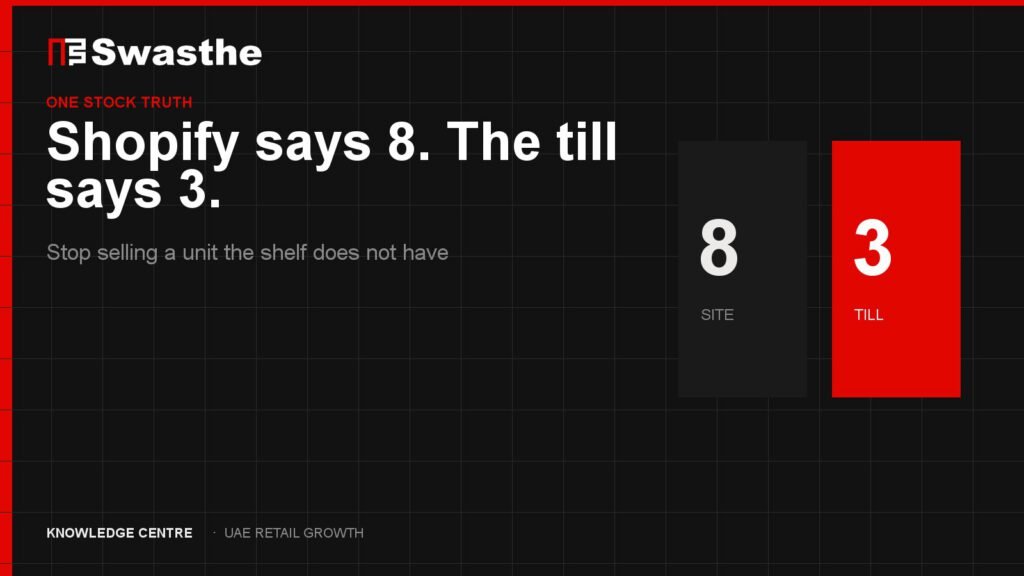
Shopify POS inventory integration, for a UAE retailer, means one available-to-sell number for a SKU whether the customer is on the website or at the mall till. If Shopify says 8 and the shelf says 3, one of those screens is about to take money for a unit you cannot hand over.
Shopify is a sales channel with its own checkout, and it can hold inventory by location. A physical store often already has a till that is not that location. The work is to stop those two systems publishing two truths. This is an operations problem. It is not solved by a new theme or a larger ad budget.
What Shopify owns and what the till owns
Shopify owns the brand site: the product page, the online checkout, and — if you use Shopify as the till — the in-store sale on that same account. Locations in Shopify can carry their own quantities. That design works when every place you fulfil from is a Shopify location and every sale writes back immediately.
A separate POS owns the mall queue: VAT receipt, cashier, return, and the card terminal on the counter. It sees the customers standing in front of it. It does not automatically see a Shopify order placed at 11pm unless somebody connected the two.
A workable split used by multi-branch retailers:
- Shopify remains the shopfront and the online checkout.
- The store till remains the tool cashiers actually touch during mall hours.
- One inventory record is allowed to say how many units are available.
- A sale in either place reduces that record before the next customer can pay.
If you collapse everything into Shopify POS, do it on purpose, with the mall hardware and the VAT receipt tested on a Saturday, not as a side effect of a redesign. If you keep the current till, connect it. The job split between billing and stock is in POS versus inventory software.
The number that must agree
Staff argue about sync frequency. Customers feel available-to-sell.
Available is what you can still promise: on the shelf or in the bin, not already paid for, not in a van between branches, not a damaged unit, not a display you will not sell. A Dubai Marina store and a Sharjah warehouse are two locations. A unit in Sharjah is not available for a two-hour pickup in the Marina unless you have said so on the product page and the pick ticket names Sharjah.
Test five fast SKUs this week:
- Write the Shopify quantity, the till quantity and the physical count.
- Sell one at the till. Refresh the product page on an iPhone. The page must refuse the unit you just sold.
- Place a Shopify order and pay. The till’s available count drops before a cashier can sell the same unit to the next person in the queue.
- Refund one. The unit returns to available only if it is sellable.
- Transfer one to the other branch. Neither location offers it as local stock while it is on the truck.
If step 2 or 3 fails, you do not have a merchandising issue. You have two ledgers. Pause ads that point at those SKUs until the test passes. The pattern of ads that look successful while this is broken is in why sales disappear after the click.
Branches, Amazon.ae and the overnight order
UAE catalogues rarely stay on one site. The same serum is on Shopify, sometimes on Amazon.ae, sometimes on Noon, and on a shelf. Each extra channel is another place that can sell the last unit.
Shopify’s location logic covers Shopify. It does not, by itself, police a marketplace listing that was updated from a spreadsheet on Thursday. Build the rule in this order:
- Decide the fulfilling location before the customer pays. Pickup names the branch. Delivery names the warehouse or the store that can still meet the cut-off.
- Lock or reserve the unit at payment, not when the packer notices the order at 9pm.
- Push the new available count to every channel that is allowed to sell, the same day.
Noon is a major UAE marketplace. Treat its quantity as something you must reconcile. Do not assume a connector exists because the brand name is familiar. Amazon.ae and the website need the same discipline. How the channels sit together is omnichannel retail in the UAE. What happens after payment — pick, pack, courier — is online order to last-mile.
Paid oversells are the gap
The architecture observation: a commerce channel and a till can both be “working” and still sell the same unit twice. The customer experiences a confirmation email and then a WhatsApp apology. You pay the gateway fee, the refund, the staff time and the review.
Cheap traffic into that path makes the loss faster. The audit question is not which app has the longest feature list. It is whether a sale in one place removes the unit from the other before the next payment.
ElintOm is one retail operations platform aimed at that join. On its current site it describes multi-store POS, real-time inventory, and Shopify, Amazon, the website and in-store sales landing in one order queue, with a POS sale updating the inventory online channels use. That is a fit when the leak is the till and the stock record. It is not a reason to close a Shopify store that is already your shopfront. Shopify stays the channel. The operations platform is the ledger the channel should read.
What to do this week
Audit the five SKUs. Build the product page so it only offers what the fulfilling location can ship or hand over, including emirate and cut-off. Connect the till and Shopify to one available count. Grow ads and marketplace spend after five paid tests match the bin.
If the screens already disagree and you want the leak named across stock, checkout and demand, start a Free Growth Audit. If the next gap is the pack bench and the courier rather than the quantity, continue to where the online order gets stuck. If you are weighing the operations platform itself, read ElintOm against the five-SKU test, not against a slogan.
FAQ: Shopify POS inventory integration
Does Shopify sync inventory with a POS?
Shopify keeps inventory for its own locations, including Shopify POS. A different till — the one already on your counter — syncs only if you connect it. Assume nothing until a test sale on the till changes the product page.
Should the website or the store be the stock authority?
Pick one record both must obey. For many multi-branch UAE retailers that record is the operations layer that sees every branch, not the shopfront alone. The shopfront publishes the number. It should not invent a second one.
What about Amazon and Noon?
They are additional places that can sell the SKU. Include them in the same available count. A Thursday spreadsheet feed is already late for a Saturday sale.
Will a Shopify app fix overselling?
An app can move data. It cannot choose your fulfilling branch or your cut-off. Test a real sale. If the second channel can still take payment, the app has not finished the job.
What is the next page if stock is already the known leak?
Start a Free Growth Audit, and look at the operations platform if the till and the channels need one queue. If orders pay successfully and then stall at packing, read the last-mile article.